Justice Playthrough #132: FLAMBERGE

Your plan will not survive contact with the enemy. Flaberge is in many respects very raw and clearly a work in progress, but its central conceit of watching your choreographed battle plans go straight to hell over and over again makes it fun and damned compelling just the same.

Page 10, Game 20: FLAMBERGE by msb /// hydezeke

Long ago, the land was savaged by war. So, your ancestors said Fuck This and violently ripped your homeland out of the ground and turned it into a floating island in the sky. For centuries you’ve lived in peace. But something has found you.

You take the role of a young soldier, last survivor of a squad devastated by mysterious invaders from below. You’ll explore the land and, in proper adventure game fashion, assemble your team of heroes as you attempt to put right what has gone so terribly wrong.

Flamberge brings an old-school brother-can-you-spare-a-pixel graphic style that I find immensely appealing. Check out this map of the overworld:
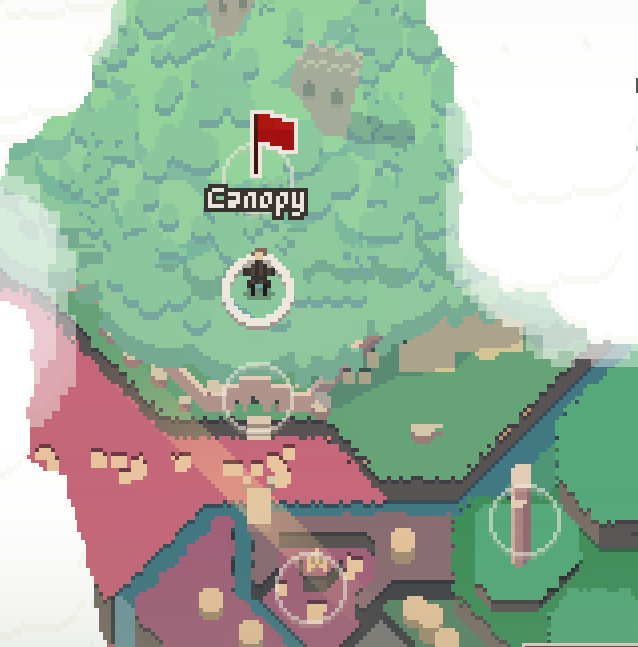
Follow the flag to adventure!

It also sounds fantastic, with a standout piano soundtrack. (My wife actually commented that the music for my game was suddenly “bangin'” and wondered why it had gotten so awesome. I’d earlier been playing Gloomhaven, a game from a much larger publisher.) The sound effects have a nice “crunch” quality to them in general, and just feel satisfying.

But the real selling point here is the combat system. It’s turned-based, but with one hell of a twist. You have to plan out what you’re doing ahead of time. You tell your people where you want them to go and when you want them to attack, and they’re off!

Unless you caught them by surprise, the enemy will promptly turn this into a huge clusterfuck by not being where you want them to be when you want them to be there, the bastards.
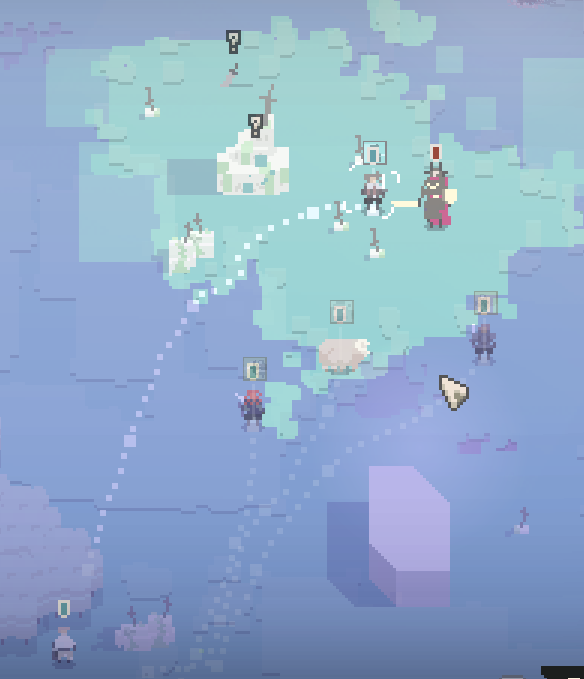
All right, I’mma come up on him from behind, you get right up in his grill, you shoot him, and assuming he remains perfectly stationary….

It’s not uncommon to botch a charge and end up hauling-ass WAY farther than you intended, possibly stumbling into visual range of another group of foes that you would preferred to have dealt with later. Whoopsy-doodle.

Combat mechanics are simple. Your attack does X damage; subtract your target’s armor (assuming they were where you wanted them to be) and subtract the result from their hit points. Easy-peasy.

You can even reduce the power of your attacks to account for uncertainty — which is often the smartest move. In exchange for a smaller attack strength, you can designate an area to go looking for foes instead of a straight line. It adds a very nifty gambling element to the proceedings, particularly when dealing with crunchybois with high armor values.

But as I mentioned, the game is still under development, and it shows. The developer says that it’s half done; they have three chapters in the can, and have three more to go to complete the story. I’m really hoping they’ll come back and polish some of the core gameplay elements, however.

There’s no “undo” mechanism for plotting your moves, at least none I could find. This results in a very unforgiving interface, where a single errant mouse twitch could spell disaster by taking one of your peeps too close to the enemy. There’s a timeline displayed, but I couldn’t figure out how to manipulate it; if I want something to happen later in the turn such as the healer holding off on his heal-bomb until everybody has congregated, I have no idea how to make that happen without the guy running in circles.

There’s also a weird thing where if you don’t collect loot while the fight is in progress, the game won’t let you collect it after you’re done, even if you wipe the field of opposition. Also, there’s one guy in the enemy camp who’s clearly recruitable, but I have no idea how; I was hoping getting closer to him would trigger some sort of dialog, but nope. I didn’t recruit him so much as … murder him. Maybe I have to ignore him completely? That seems counter-intuitive.

But what I most desperately want is a slow-motion replay option. When you hit the “Execute” button, things happen VERY quickly. My plans often went wrong, but I was often very unclear as to WHY. Did the target move before my archer could get the shot off? How close was the miss? Why did that guy get flattened? Didn’t I have his “defense” option selected? The game makes it harder than I want to learn from my mistakes — even though I’m clearly showering myself with learning opportunities.

The story is all right. I suspect English isn’t the dev’s first language, as the exposition and dialog can both come off a tad stilted. It also suffers from the problem of not telling me enough while telling it to me too slowly; the story stuff can really drag, and yet at the beginning of the game, I honestly didn’t know I was up in the floaty-island defending it from invaders from below.

That having been said, the story takes a turn for the weird in the third chapter, and I am fucking THERE for it.
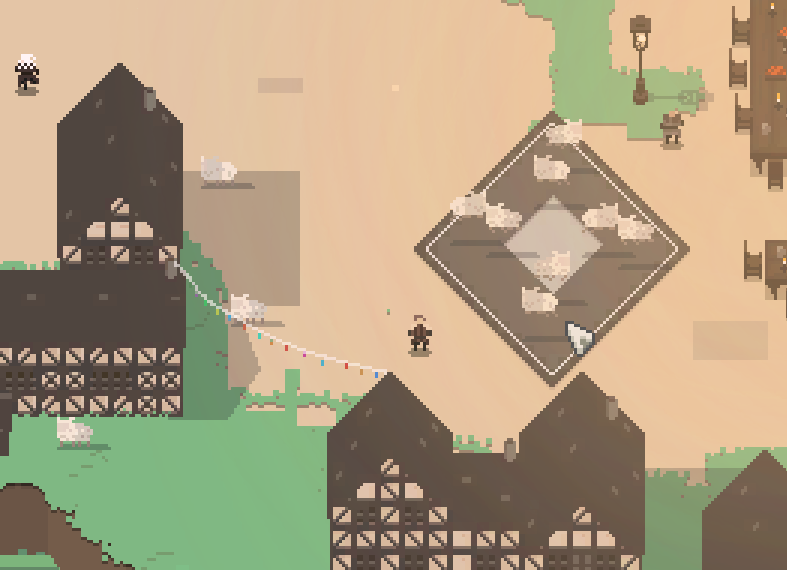
You KNOW the party’s gotten real when they bust out the dancing diamond

You meet the people of the town you just saved. They are sheep. Literal sheep. So is their king. Nobody thinks this is in any way odd.

This is like ten times as much personalty as the game had displayed up until this point, and I would have loved a lot more of this loopy creativity.

It feels like there should be more to explore; the overland map is often just an exercise in going from point to point. There’s a shopping mechanism, but it feels weirdly half-baked. I would have liked my protagonist’s personality to have had a trait beyond “dutiful.”

It’s one of those games where it’s easy to lose yourself picking at what it’s getting wrong, which is a mistake. It DOES have a ton of room for refinement, but that shouldn’t distract you from the core truth:

It’s fun as hell.

I’m going to set this game aside. At some point in a year or two when I’m poking through these entries, I’ll stumble across this one and be all “Oh, yeah, Flamberge! That was actually kind of awesome. I wonder what it looks like now.” And then I’ll download the latest version and see what the developer has managed to improve.

This game can only get better — and it’s already pretty damn good.

This is absolutely worth a look.

Will this next game allow me to use a sheep as a motherfuckin’ tank?

Page 55, Game 17: Analog Zine Issue 1-9 by Analog Fanzine

“All the issues so far”

As balls-out weird as the zines have been in this trawl, there’s absolutely no way to know for sure, is there.
Justice Playthrough #131: Midboss

Everything about this game’s concept and setup make me want to love the hell out of it. But ultimately, it’s … fine.

Page 1, Game 22: MidBoss by Eniko

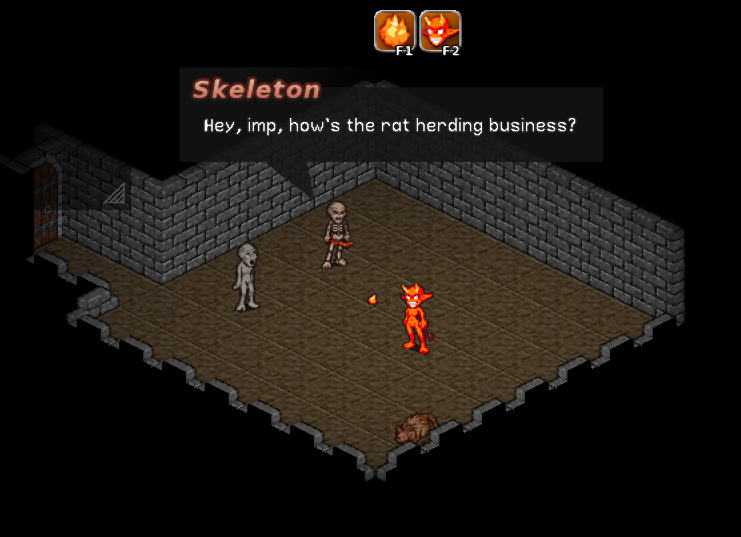
You are an imp, the lowliest denizen of the dungeon, and you have gotten sick of your co-workers’ bullshit. Luckily for you, adventurers are attacking the keep! Time for you to book it and get the fuck out of there, presumably to a better job.

Unfortunately, your employment contract is kind of a bastard, so they’re not letting you go easily; you’re going to have to fight your way out. Luckily, you’re good at possessing the corpses of your fallen foes. Add their skills to your repertoire, and escape!

Just so we’re clear, I’m murdering the shit outta BOTH of you guys

Midboss is an isometric roguelike, where every level after the first is procedurally generated. The game’s big selling point is that you can possess your foes if you defeat them, which will at the very least heal you up and give you a bunch of new stats and abilities to work with.

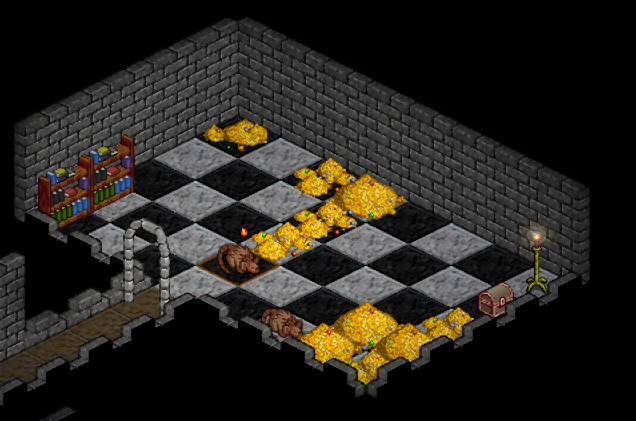
Also, you’ll find loot. So much loot. So very much loot. Such loot.

I’m that angry rat in the middle, and I’m about to go on a lootenanny

There’s a lot to like here. All the standard roguelike elements are present, but (obviously) presented with very accessible graphics. There’s a lot to explore, and the fights do a good job of presenting you with a sense of escalating danger.

But there’s a lot of it just didn’t work for me. The loot system immediately jumps out as an example. Midboss goes in HARD on intermittent reinforcement; loot is plentiful, but the vast majority of it quickly becomes vendor trash. Once you get a decent set of gear going, you rarely pick up anything worth using. As a result, loot quickly stops becoming rewarding and instead becomes a nuisance, a chore to be managed. The game even knows it, and allows you to deconstruct useless items into telescoping scrap piles so you don’t have to continually go back multiple floors to the last place you saw the merchant hiding out.

And a lot of the gear’s bonuses tend to be very incremental; yeah, a +10 bonus to your sorcery definitely gives your combat spells some kick, but for the most part, you’re talking about doing an extra point of damage here, taking one fewer points of damage there. I found that I almost never went “Ooh, cool, this is totally gonna open up new gameplay options for me!” when I found some shiny piece of loot, even if I wound up using it. (Unless I was playing like a dumbass and overlooked all the items that would have expanded the game for me, which is possible.)

A similar problem exists with the monsters you can upgrade into. Even when you switch forms, you can carry around traits of previous skinsuits you’ve mastered (by which I mean “Killed a bunch of stuff in”), so in theory, you should be hopping around like mad to deepen your bag of tricks, right?

Well, not really. You’ll want to jump into the rat first; it’s always your first option and it’s better than your starting form, so you may as well. Once you get the whole “Rat” thing down, you’ll want to nab a vampire bat, because they can drain hit points from other creatures. Healing is tough to come by in this game, so being able to harvest other creatures for health is just HUGE. Of course, if you’re going that direction, you’ll want to pimp your magic stats, just to make sure you deal maximum damage and receive maximum healing.

And from there, it’s kind of … eh? I bounced around from zombies to skeletons to flaming swords to acid-spitting bats, and none of it was all that exciting or interesting. Just lots of variations on “You do a few points of damage to that other guy.” Certainly nothing as useful as the vampire bat’s drain ability; my playstyle evolved to lean on bloodsucking and fuck around with a few other things as the game went on. (If you get really good at your native form, you can chuck inventory at opponents for damage, which is hilarious to me because it feels like the game is admitting that shit is useless as anything but ammo.)

I gave this game so many opportunities to impress me, because honestly, I want to love it. This thing LOOKS awesome. But the gameplay feels very samey to me. Maybe that gets better the deeper you get into the game — I keep getting my ass handed to me once the ghosts start showing up, so I’m clearly not an expert — but even so, that’s a lot of time commitment to ask of a player before the game starts getting good.

The dungeons may technically be random, but I couldn’t help feeling “I’ve done this already” with each new one I’ve visited. In a good roguelike, each run should feel like it’s giving you the opportunity to explore some cool new facet of the game you haven’t discovered yet. This just feels repetitive.

The game gives you the ability to take whatever form you can find, but it doesn’t give you a REASON to actually do it. If I play this game again, I know it’s going to be a lot like the other times I’ve played it, though maybe a few numbers might be higher or lower. I want more.

Do I recommend it? Tentatively. If you really dig roguelikes, then what the hell, it’s far from the worst one you’ve ever played. It certainly has personality to spare. But if you’re not alread a fan of the genre, I don’t think this is the game that’s going to win you over. I just can’t help but feel like the game should offer a much more interesting experience than it actually does.

Is this next game going to let me murder the crap out of my evil co-workers?

Page 10, Game 20: FLAMBERGE by msb /// hydezeke

“FLAMBERGE is a turn-based tactics RPG featuring free movement and simultaneous turns.”

Depending on its attitude towards friendly fire incidents, this just might be an emphatic “Yes.”

Forbidden Lore Design Diary #9: Off the Trail, But With Map In Hand

Latest development session involved getting into the saving & loading tutorial — from the outdated Version 1 of the tutorial. Version 2 still isn’t out.

But that’s okay. I’ve been looking forward to seeing if I can start writing my own code in this thing.

Step 1: Refactoring! The tutorial recommends setting up a “constants” file, for all the key things defining the game and what it looks like. (IE, how large is the map? What are the potential room sizes? Where is the message log located on the screen? Etc.) For this, I did copy-paste the tutorial’s file as my starting point, then set about adapting it to what my code actually looked like.

This proved a bit challenging, as the constants it defined were a bit all over the place. This drove me to do some refactoring, to make the code closer to my version of “tidy.” For instance, why was the code responsible for sending data to the message log defining the log’s x/y coordinates every time it was called? There’s a MessageLog object, after all; why not just tell that thing where it lives when you create it, and then not worry about it?

Eventually, I got the code to a point where the “main” file was the only one that cared about the “constants” file, and acted as the traffic cop responsible for sending that data to the parts of the game that needed it. Seems to work pretty well.

Also wound up having to do some debugging to figure out why my “fireball radius” feature (which I’m inordinately proud of) stopped working. Turned out I’d done something foolish to the order in which things got rendered. It was frustrating, but at the same time, I felt very confident when I managed to track-down and correct that problem.

It turns out that saving the game state to a file is piss easy, even easier than the tutorial suggested. The tutorial was telling me to save all these objects individually, but I quickly realized that the only thing I actually needed to save was the “Engine” object. Had a little trouble installing the Python package used to serialize the object, but the problem turned out to be that Python 3 comes with that package pre-installed. Love it when the solution turns out to be “You never actually had that problem in the first place, dumb-ass.”

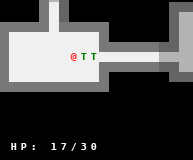
So, for proof of concept, I had the game save itself after every action. (On the to-do list: confirm that the game is saving itself ONLY after the player acts, and isn’t saving itself every time the mouse twitches. That would be inefficient.) Then, when the game powers-up, it first checks to see if the save file exists; if it does, it loads it instead of creating a new dungeon.

It works! (After I figured out that the data serializer and the file manager have a difference of opinion on whether one should actually specify a “.dat” extension for the savefile.) It works SO well that, if you get killed, the next game will cheerfully reload the dungeon that has become your tomb, with you still laying there surrounded by the monsters that killed you. So, erm, maybe death should delete the save file.

It has the same problem if you win, though; clear the dungeon of monsters, and your next playthrough will load you into the corpse-filled site of your underground rampage, with nothing to do but wander and contemplate the ultimate futility of violence. So I probably do need to define some formal “You won!” condition just so I don’t have to manually delete the save files.

From there, the tutorial would like me to create a “Main” game screen, from which to ask the user if they would like to start a new game or continue an old one, and … goddamn, that’s actually going to take some effort. Looks like the old version of the tutorial actually made you write some dedicated UI code for stuff like that. The new tutorial lacks that feature. So, I think that’s my next task: centralize all the pop-up menu code into some convenient centralized package that I can use to communicate with the player.

Turns out that saving a game is dirt simple, but asking the player if they’d like to save the game is quite challenging. Roguelikes are fuckin’ weird.

Forbidden Lore Design Diary #8: The Sidewalk Ends with FIREBALLS

Got some worrying personal information tonight. So, I buried myself in programming. Nothing like some scrolls of fireball to distract oneself from loved one suffering over a thousand miles away.

Today’s lesson: ranged attacks! Status effects! Crowd control!

In addition to Potions of Healing, the tutorial has now guided me to create a Scroll of Lightning Bolt, Scroll of Confusion, and Scroll of Fireball. Since magical shenanigans lie at the heart of the game I want to create, I was paying close attention.

Of course, if I’m adding arcane devastation to the mix, I felt like I had to beef-up the monsters a bit. Instead of randomly sticking between zero and two of them in every room, the engine now seeds the room with between zero and five of them. Only seems fair.

I was also not impressed with how the tutorial handled fireballs. To show the area of effect, it presented a simple square — even though the blast radius is very much a RADIUS. You know, a circle. So the beasties in the square may or may not have gotten tagged by the spell depending on how close to the corners they were.

Time to do some off-road coding.

    def highlight_radius(
            self, 
            center: Tuple[int, int], 
            radius: int,
            console: Console,
            bg_color: Tuple[int, int, int], 
            fg_color: Tuple[int, int, int],
        ) -> None:
        """
        Twiddle the foreground and background colors of all visible tiles within a circle
        """
        x, y = center
        max_x = min(x + radius, self.width)
        max_y = min(y + radius, self.height)
        min_x = max(x - radius, 0)
        min_y = max(y - radius, 0)
        for check_x in range (min_x, max_x + 1, 1):
            for check_y in range (min_y, max_y + 1, 1):
                if (self.distance((x, y), (check_x, check_y)) <= radius 
                        and (self.tiles['walkable'][check_x, check_y])
                        and (self.explored[check_x, check_y])):
                    
                    console.tiles_rgb["bg"][check_x, check_y] = bg_color
                    console.tiles_rgb["fg"][check_x, check_y] = fg_color
        

    def distance(self, start: Tuple[int, int], end: Tuple[int, int]) -> int:
        """
        Returns the distance between two grid points, rounded up.
        
        Might someday be enhanced to care about whether or not those two points on the grid
        can actually see each other; for now, just a Pythagorean Theorem wrapper.
        """
        x1, y1 = start
        x2, y2 = end
        return int(round(math.sqrt((x1 - x2) ** 2 + (y1 - y2) ** 2)))

Yup, that’s effectively the first proper Python code I’ve written myself. Results in something that looks like this:

WHO WANTS SOME

Everything highlighed in red there is gonna get hit by a fireball. How do they feel about it?

FRAGABOOOOM

They were not fans. Killed the four orcs outright, and definitely took a chunk out of both trolls.

In addition, I figured out how to update the mouseover text to show you the critter’s current health. The game needs more feedback in general, but that’s a first step towards showing you that what you did had an effect even if you foe didn’t drop.

But this iteration of the game marked another milestone. After I took that screenshot, I went back to the code for another round of fiddling. At that point, I should just escape out of the game and restart it … but I wanted to see if I could keep going. After blasting that room, I wanted to see if I could keep going, clear out the dungeon before I got overwhelmed.

And I did it. And I felt kinda like a badass.

This was the first time I had fun with this game as a GAME.

It is still, objectively, kind of a piece of shit. But it’s a piece of shit that has stretches were it’s damned interesting. This is kind of awesome.

Anyway. I’ve hit the end of this version of the tutorial. The tutorial is an update of an older version that just hasn’t gotten to all the chapters the author wanted to cover. So I can keep going, but I won’t be able to copy-paste like I used to. Now, I’m going to have to figure out a lot of the details on my own.

That feels manageable. That feels like a good exercise at this stage, really.

So, next step: figuring out how to save the game.

I wanna take a BIG ol’ detour into laying down an initial version of the magic system, one that doesn’t rely on one-shot items. But, no, saving and loading the game is super important, and I should probably figure out how that works sooner rather than later.

Forbidden Lore Design Diary #7: Talk To Me Over A Drink

Banged-out two episodes of the tutorial today: creating the interface, and items & inventory.

Basically, I can now communicate with the player AND give the player shit to pick up. Whoo-hoo!

HP bar! A healing potion just lying on the ground! Text to tell me WTF is going on! So much game!

I’m starting to get a little judgy about how the code is architected, though. I was curious to know if the toolset I was using had in built-in tools for pop-up interfaces, and the answer is … kinda?

I now have pop-up windows for both message history and for my inventory. I was expecting those to each be part of a new class of some sort, but nah, each of them is a bespoke entity crammed into the code which processes commands and figures out what to do next. That just seems sloppy to me; I would have expected those windows to be their own thing, somehow.

That HP bar WAS its own thing, but I know that I’m going to want a mana pool of some sort to power the player’s spellcasting. So I’ve already refactored that into a more generic component so I could get the mana-point bar in there. (Right now, it’s purely for show; I definitely haven’t implemented spells yet.) They’ll likely be joined by an XP bar at some point. For the final game, I don’t think I want to use an experience-point-based progression system, but for the early going, it’ll do.

I’m also a bit confused by the decision to make all items default to being “consumable.” I’m hoping that’ll get rolled back later in the tutorial.

So, yeah, I’m seeing a whole bunch of shit I think I’m going to refactor after I get to the end but before I get into my own version of the game hot and heavy.

But, still. This game is coming together, and that’s really cool.

Justice Playthrough #130: Unmoored

A solo game that wants you to have a die, a deck of cards, and a Jenga tower to play it. I guess those are a thing.

Page 39, Game 27: Unmoored by Lari Assmuth

Terrorists are fucking the world, so the Time Cops are gonna send you back in time to deal with them before they ever become a problem. But as one of the game’s acknowledged sources said, science isn’t exactly an exact science with these guys. You’re getting jerked around the time-space continuum willy nilly, losing pieces of your identity as you go. You are, as the title suggests, unmoored.

You’re probably fucked. But you still have a future to save, dammit.

You draw cards, and write entries in your log based on what they’re telling you. At various points, you’ll pull blocks from the Jenga tower. When it falls, ya done. Hope you accomplished something before you lost all traces of yourself to temporal Alzheimers.

I don’t have a lot to say about this one, other than it looks really interesting. Which is why I don’t have much to say; I might just want to experience this one for myself. What the hell, if I get my hands on a Jenga set and have an afternoon to devote to what’s basically a writing exercise, I might very well give it a try. If it sounds appealing to you, it’s worth a look.

All right, Al. Where am I headed next?

Page 1, Game 22: MidBoss by Eniko

“A possession based traditional roguelike with turn-based gameplay.”

Ziggy says I’m an orc?! Oh, boy.

Justice Playthrough #129: Sanguine Sanctum

New rule: if your game makes me feel like I need to barf, I’m gonna say mean things about your game.

Page 7, Game 27: Sanguine Sanctum by Modus Interactive

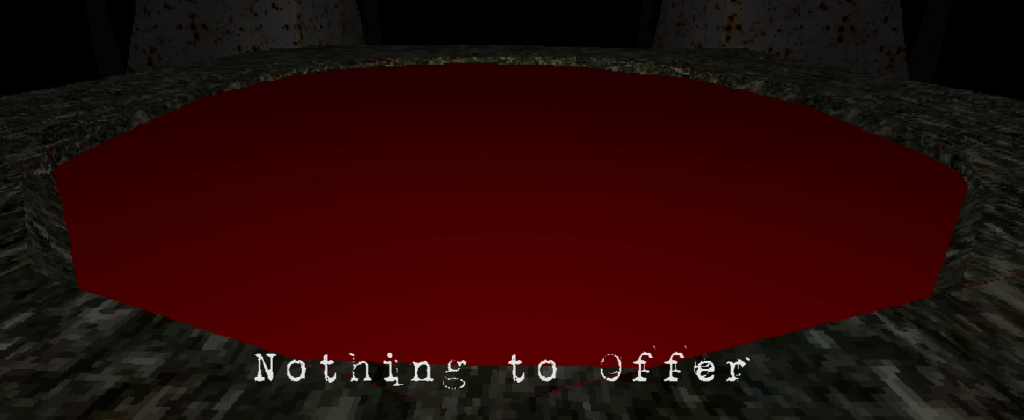
The pool of blood wants stuff. Go find stuff, feed the pool of blood.

Feeling kinda judged here, pool of blood

Some games are about telling a story, others are about interesting/challenging gameplay. Sanguine Sanctum punts on both. Finding the various red lumps coveted by the pool of blood is just a matter of wandering around, clicking/stepping on enough things for the game to reward you. What is the pool of blood? No idea. Why do you want to feed it? Eh, it’s not like you have anything better to do. What’s going to happen if you feed it? Fuck if i know. Maybe it’ll get up and direct Season 2 of Firefly or tear the world in half or something, I don’t know, I’m just a cat.

No, this one’s all about the mood. Sanguine Sanctum just wants to establish a creepy psychedelic grove and let you wallow in it. So, how does it do that?

The system … is down! The system … is down!

By throwing sweet statue rave parties, of course!

Actually, it just kinda throws weird shit against the wall. Maybe some of it will stick for you.

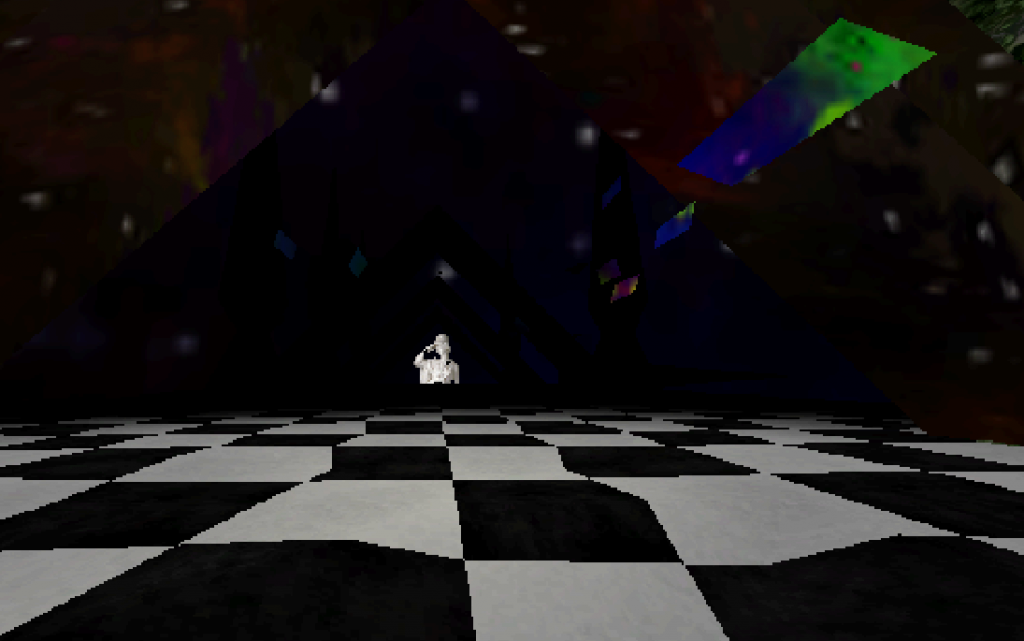
That really didn’t engage me, but what the hell, it’s fine. Where the game outright lost me was the sections — and there are many of them — when the game deliberately fucks around with motion in order to try and enhance the sense of wrongness.

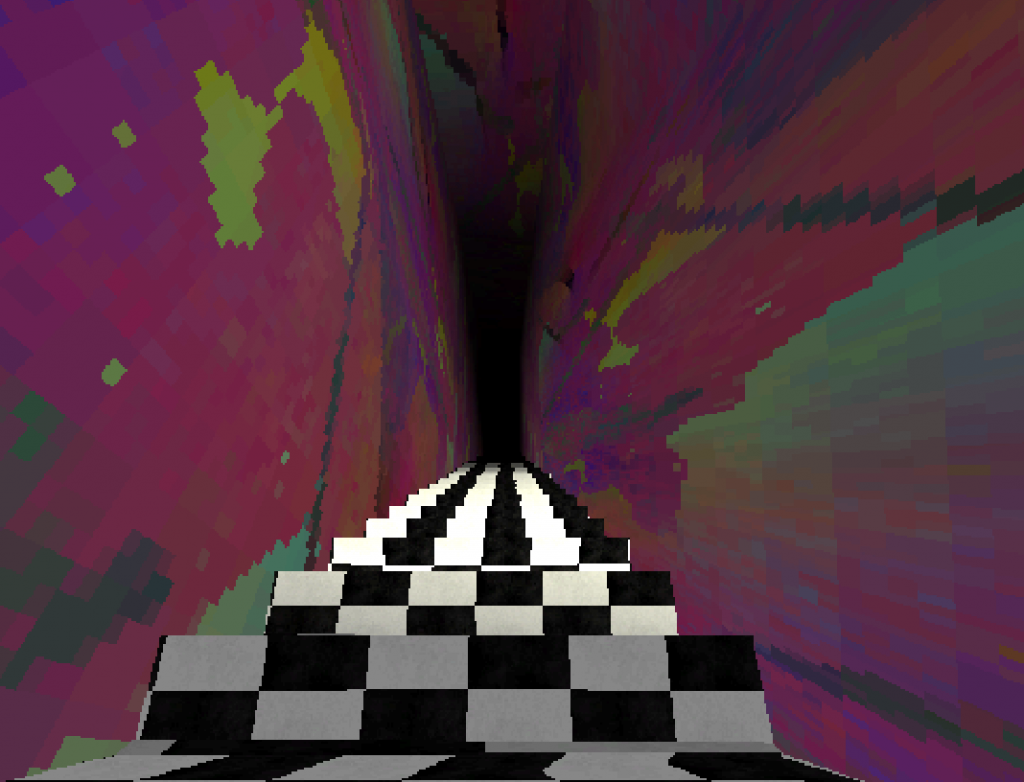
Prepare to enter the tie dye zone

I’m too basic to record animated screenshots. But the game likes to do this thing where the walls — like the ones above — move at a different speed than the floor. You’re walking past them, but they’re not moving like they should! Creepy, right?

Actually, for me, it induced motion sickness. I played this game for about half an hour, and came out of it needing to lie the fuck down. It wasn’t fun, it was just nasty.

So, yeah, I’m not gonna play this one to the end.

If you’re looking for a creepy game driven entirely by visual mood and read the “motion sickness” bit and were like “Pfft, what a pussy,” then by all means, give this one a look. But I definitely can’t say I recommend it.

What physiological reaction is this game gonna provoke?

Page 39, Game 27: Unmoored by Lari Assmuth

“You are a time-traveller on a crucial mission, but something has gone terribly wrong…”

Ah, it’s gonna stimulate the Bill and Ted centers of my brain. Most excellent.

Justice Playthrough #128: Mutiny Island

Promising game, but much too raw in its current state.

Page 15, Game 21: Mutiny Island by Elushis

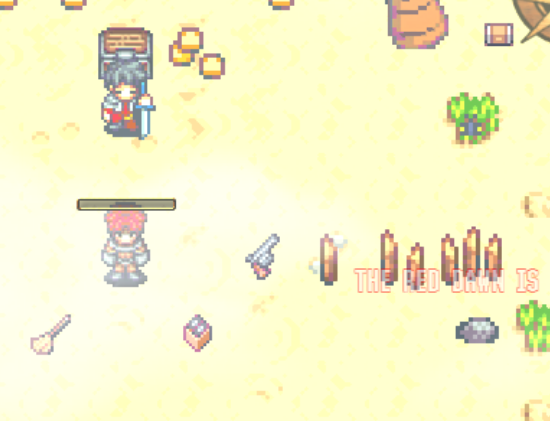
You’re the captain of the pirate ship Red Dawn, but oh, no! Mutiny! That scoundrel Morgan the Mutineer (one assumes he put “Morgan the Perfectly Loyal Crewman” on his job application, the lying swine) has seized control of your ship. You’ve been dumped unceremoniously on the titular Mutiny Island, where presumably you’ll find your way back to civilization and make them rue the day the didn’t simply shoot you in the face.

Welp. Nothing for it but to wander around picking-up random bullshit.

It looks lovely, like an old-school top-down JRPG. And I gotta give it props for the theme. Unfortunately, it’s let down in two crucial areas.

First, teaching itself to you. It really doesn’t. I had to trial and error my way into what the buttons do, and the “Options” page doesn’t help at all. I finally learned which button was “Attack” — great! It was Button 5 on my controller. Which one is that? (Turns out it’s the right bumper.)

But a vastly larger problem is that this game is SLOOOOW. I don’t mean slowly paced, like a self-indulgent “interactive” novel. No, I mean physically; the framerate absolutely CHUGS, and I have absolutely no idea why. My PC is a quad-core Intel i7-8550U with 16 gigs of RAM. It’s not a top-of-the-line gaming PC by any stretch of the imagination, but it’s not a total piece of shit, either; it’s handled much more graphically ambitious games than this.

But I don’t think a faster processor would have helped. I kept an eye on my CPU and Memory stats, and they seemed fine; despite how badly it was laboring, the game wasn’t maxing-out my machine. There’s something REALLY wonky going on in the underlying programming. I noticed that when I found an area beneath the island where there was less stuff, the game’s performance suddenly hit something vaguely resembling “acceptable.” So I don’t know what behind-the-scenes algorithm is responsible for kneecapping Mutiny Island’s performance, but until the dev sorts it out, this game is going to remain a really unpleasant experience.

The very notable lag between me pushing a button on my controller and something actually happening on the screen made combat absolutely miserable. There were a couple of times I accidentally selected a dialog option (without even getting to read it) because I was button mashing trying to get the goddamn text to appear faster.

This was especially problematic when a murderous snake jumped me while I was inspecting something on the screen. If a dialog/interaction box pops up, monsters will NOT do you the courtesy of waiting until you’re done before they murk you. Given how slowly everything reacts, that was infuriating.

There could be a nifty little retro RPG here, if it can sort out its technical issues. Until it does, though, there’s just no way I can recommend it.

What kind of performance am I gonna be looking at for this next game?

Page 7, Game 27: Sanguine Sanctum by Modus Interactive

“It desires more. Feed It. Nourish It.”

If Little Shop of Horrors has taught us anything, it’s that feeding mysterious creatures as much as they want is ALWAYS awesome. I’m in!

Forbidden Lore Design Diary #6: Let The Beatings Commence

Holy shit, you guys. It’s a game now.

LET’S PUNCH SOME TROLLS YINZ

I mean, don’t get me wrong, it’s a fucking TERRIBLE game. If I came across it during my bundle playthrough, I’d pimp-slap the bejesus out of it for completely wasting my goddamn time. Tactics are simplistic and obvious, there’s no mechanism for healing yourself or upgrading your abilities, there’s next to no on-screen feedback for what’s happening, the win state is boring, the lose state is even more boring … this game is shit.

But, nevertheless, after this tutorial, I can now roam the dungeon and punch orcs! And punch trolls! And they hit back! And can kill me, which only seems fair! Trolls hit harder.

The code that makes this stuff happen is, by and large, comprehensible to me. I don’t get every nuance. (And it doesn’t help that this edition of the tutorial begins with “Okay, this is how we’re going to totally reorganize the code, because this way is better.” The author is probably right, but still … grr. Would have appreciated if they’d go back and retrofit the existing tutorials. Eh, it’s free learning, I can only bitch so much.)

Even if I don’t get every nuance, though, I can see where stuff goes. When I think about “Okay, how am I going to tweak this to handle an action-point-based mechanism instead of strict turn-taking?”, I have a really good notion of what needs to happen where. It’s pretty dope. I’m probably wrong in several important respects, but I know where to start.

Even more fun, I got to do a little debugging!

The latest version of the code knocked-out the feature by which you could hit “Escape” and quit the game — but only if you were still alive. Once you were dead, you could escape-out just fine.

Trollums McGee has killed me, and is now just standing over my corpse. Apparently, my existence was the only thing giving his meaning.

I thought it was due to some nuances I wasn’t understanding in terms of how the event handlers were firing, but naw, there was just a block of code that hadn’t been copied over, but should have been. So MY code is actually infinitesimally better than the canonical code at this stage of the tutorial!

AND I figured out how to dump objects to the console for debugging purposes, which is super valuable. Also inadvertently got a sniff of just how many events get fired every time the mouse twitches on-screen. Spoiler: several.

Just for giggles, I also tweaked the AI so that the monsters don’t need to see me to bum-rush me; in this version, they all have security cameras and walkie-talkies. Doesn’t take long before the entire dungeon descends upon me. This makes things pretty fuckin’ brutal.

This is really awesome. My little game may be terrible, but it exists, and it’s mine.

Justice Playthrough #127: Anomalies

For a “game” that’s about creating eldritch abominations existing beyond the shackles of Euclidean space-time, that was kinda pleasant.

Page 37, Game 10: Anomalies by Schmidt Workshops

Anomalies just chucks you straight into the deep end of the pool. What’s this game about? What are you trying to do? What CAN you do? Fuck off, pal. You’ll figure it out.

i wait wat huh how????

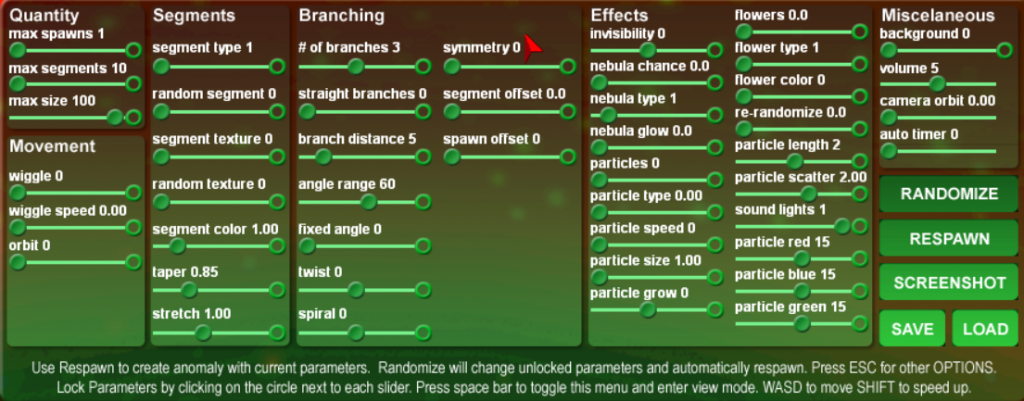
The above control panel is very seriously the first thing you’ll be presented with. What does all that shit do? Why is it doing it? Oh fuck off, who cares. Just whack Randomize and see what happens.

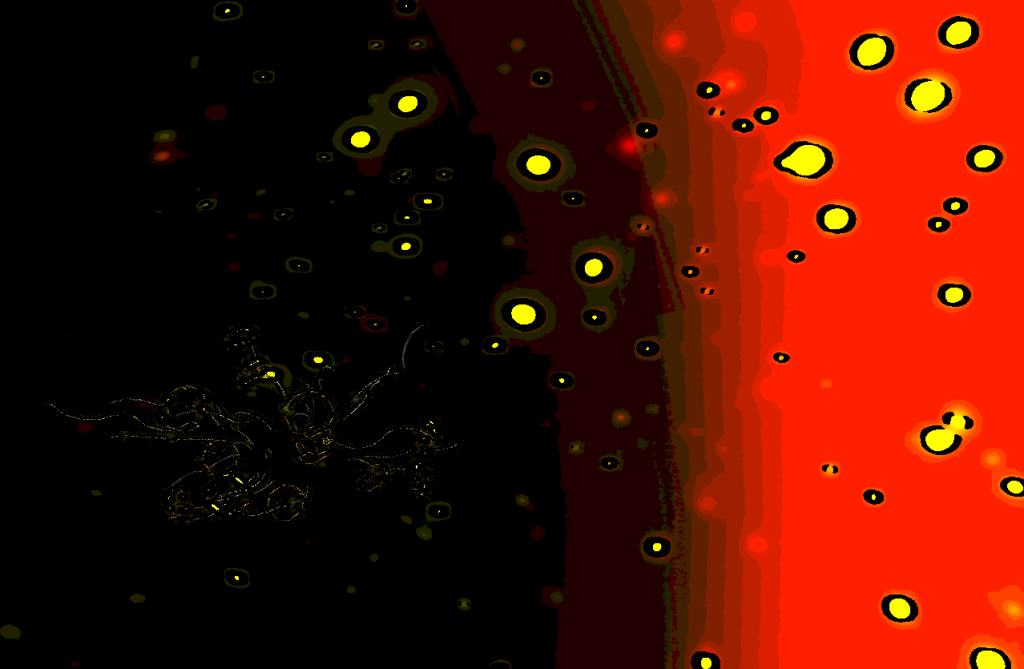
is that a thing huh wat

You can mouse around to look at a kind of irradiated donut with glowy bits passing through it. At first I thought the irradiated donut with glowy bits was the point of the game, but no. You want to mouse around until you find The Creature, when you can then inspect more closely with the WASD keys.

The Creature is entirely the point of this exercise.

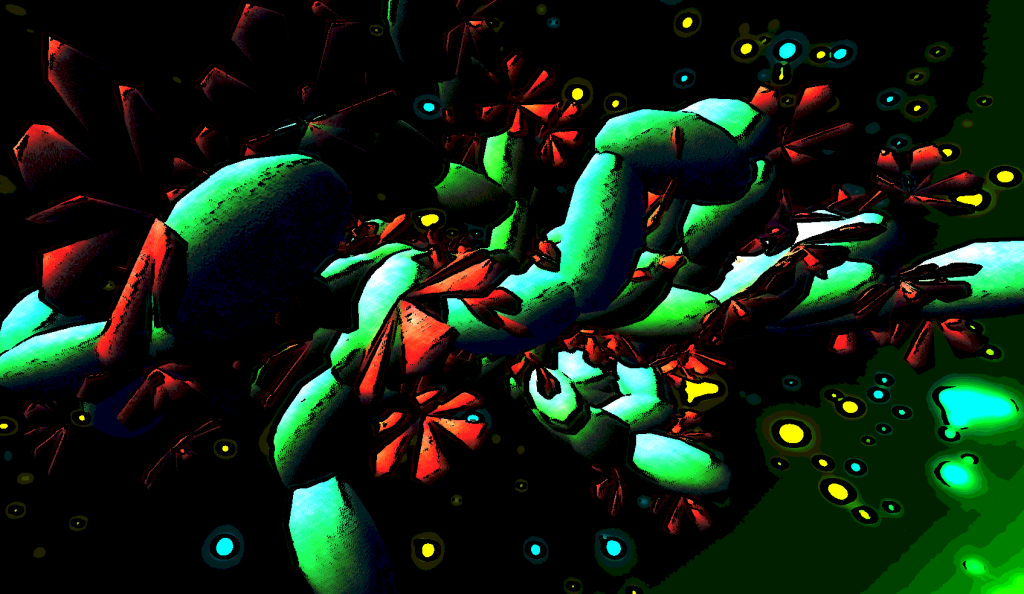
blak goat of the wuds with 1000 young?

The screenshots are seriously not doing the experience justice. That thing above throbbed and flowed, with the flowers floating and spinning across its surface, like if Yog-Sothoth were trying to impress a hippie elder goddess. The creatures sing, with strange, discordant voices. I feel like if I listen long enough, I’ll hear secrets.

helo blobbie thing

I feel like this should be a tool that lets me do something, but fucked if I can figure out what. Apparently, if you’re willing to hack some of the source images, you can fuck around with the background. I’d like to make an animation of one of these creepy eldritch fucks waving and convulsing on some sort of neutral background, for me to record and … use to freak out my players in Starfinder? Once the plague passes and we start playing Starfinder again?

I don’t know.

Chaos is the engine powering life. The spread of chaos is our triumph. And the greatest joy is the ecstasy of victory.

This is a very cool toy. I want it to somehow be more than a toy, even if I have no idea what, precisely, that would look like. But it is nevertheless a very cool toy, and I’m glad I got to play with it.

What manner of sanity-draining madness awaits in this next entry?

Page 15, Game 21: Mutiny Island by Elushis

“Mutiny Island is an open-world style pirate game. Reclaim your ship, The Red Dawn, by any means!”

Arr, ’tis to be PIRATE madness, then! Avast!