Justice Playthrough #103: Dogs Throwing Swords II: Three Barks To The Wind

Huh. Not sure what I was expecting, but I feel like I was expecting … more?

Page 21, Game 26: Dogs Throwing Swords II: Three Barks To The Wind by Rook

What’s this? Something BAD has come to the Dogwoods!

FUCK YEAH I AM!!!!

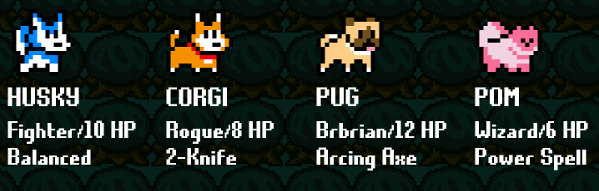
Assemble your three-dog team of heroes!

Pure badass

Now get out there and kick some side-scrolling ass! Launch flurries of weapons! Blast through level after level of–

Wait, it’s over?

Yeah … it’s over. You won.

Good dog!!!

It’s a cute enough little game, but it suffers from two problems. The first is the challenge: there isn’t much. I banged-out a complete playthrough in … I wanna say, 15 minutes or so? Made it all the way through to the end on one go. One of my doggos fell during the final boss fight, but the other two were able to bring him down. There’s really not much to the game; avoid the stuff that hurts, blast the stuff that’s trying to kill you.

You can even turn on the “Repeat” option, which just blasts away over and over and spares you the bother of holding down the “Fire” button. I’m of mixed minds about that. On the one hand, yeah, the game clearly benefits from that addition, but at the same time, I kinda wish it didn’t. I wish there was some strategy involved in there somehow.

But, nah, just blast away. Cycle your dogs’ positions so that the ones with the most health are most likely to take hits, I suppose.

When I went through the “Harvest the Screenshots” run, I could step away from the game for a remarkably long time, and my three goodbois were doing just fine with no input from me whatsoever. They got pretty chewed-on during the boss fight, though. That’s when I decided to see what the “You lose!” screen looks like, and … there isn’t one. If all your dogs drop, then two of them get back up and on you go.

You basically have to give the hell up entirely to lose this game.

Okay, fine, it’s not a hard-core gaming experience, it’s more of a cute little trifle. But … is it all that cute?

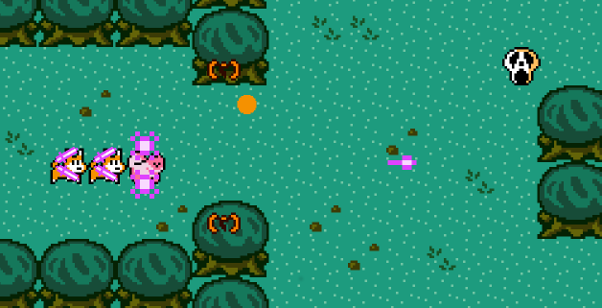
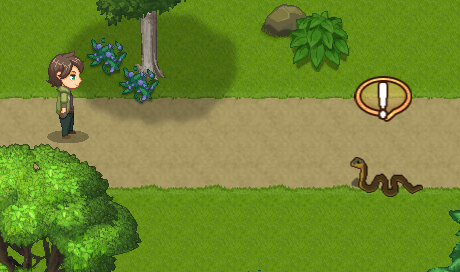
Here’s what the main gameplay looks like:

A pom and two corgos, stomping tail

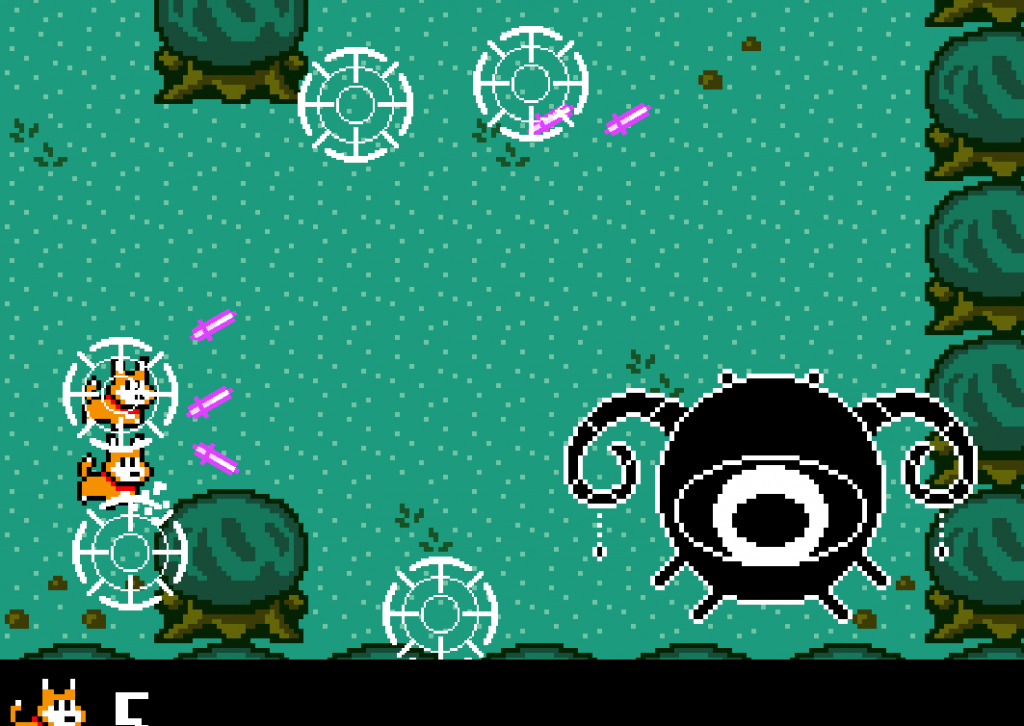
And here’s a boss fight:

Nice of him to let me know EXACTLY where his attacks are going to drop

Notice anything?

The dogs are the ONLY dog-themed element on the screen at any given time. On of the enemies spits bones at you, but that’s pretty much it. Heck, even the doggos’ attacks aren’t thematic at all; I don’t typically associate dogs with knives, or spell blasts, or battle-axes.

Everything other than the dogs is generic video-game enemy stuff. You could replace the dogs with traditional fantasy hero sprites and it wouldn’t impact the feel in the slightest.

What kinds of weapons should dogs be launching? Kong balls? Tug-of-war ropes? And what kinds of enemies should dogs be doing battle against? Mailmen, obviously, but what else? Squirrels? Cats?

If I’m going to lead a band of adorable doggos to glory, I’d like their world to be much, much doggier. Even if the gameplay does make it just a silly trifle, I still want it to have more personality than this.

Though those ARE some totes adorable heroes. They are, indeed, very good dogs. Just wish they had more of a chance to shine.

Will this next game give me even more doggy funtimes?

Page 36, Game 16: Lost in Dark Halls (Forking Paths #2) by Orbis Tertius Press

“featuring rules for Labyrinthine, a storytelling game of branching myths, for solo or group play”

I’m willing to bet a fella could shoehorn dogs in there. If he made the effort.

Justice Playthrough #102: Tabletop Archaeology 101

Ever feel like the big issue with Candyland was its lack of narrative cohesion?

Page 43, Game 12: Tabletop Archaeology 101 by avarisclari

You and up to 99(!!!) friends are competitively digging for artifacts! See who can court the most exciting danger and get the best artifacts!

Or, if you’re strapped for time, everybody roll a die, high roll wins. Same destination, shorter path.

This is a decision-free game. You’re rolling on a series of three charts, which may force to re-roll on various charts, which makes it feel like a press-your-luck game except those allow you to make choices. You are encouraged to make up stories fleshing out your dice rolls — and if you don’t, there’s literally no reason to play this game, so you may as well.

Good rolls get you points, most points/first to 45 points wins.

Also, the game closes-out with six pages of real-world archaeological artifacts. So that’s nice.

There’s nothing here, so let’s just move on.

… save to take a parting shot at the designer’s assertion that it seats from 3-100 players.

No.

No, it does not.

How many players does this game take?

Page 21, Game 26: Dogs Throwing Swords II: Three Barks To The Wind by Rook

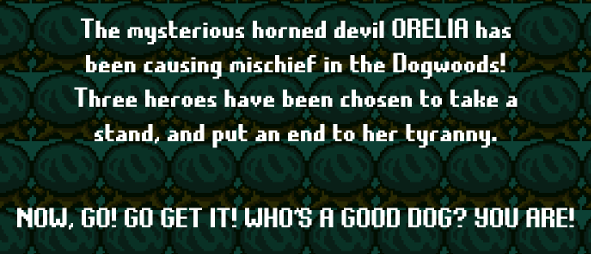
“A sidescrolling bark-em-up where you create and guide a team of very good dogs to save their home!”

Goodbois on an adventure together?!?!

I’m trying to keep my expectations reasonable. This is difficult.

Justice Playthrough #101: No Pineapple Left Behind

When I randomly select my next game, I like to close out with a knee-jerk reaction to the game’s short description. Here’s both from last week:

“Dehumanize kids and make money.”

“Oy. What have we said about “cheap adolescent nihilism,” bundle? Am I gonna need to put my rantin’ pants on for this one too?”

The answer to my question is “No.” No, I shall not be getting my rant on. I remain unmoved by cheap adolescent nihilism. But hard-won cynicism? I can still get behind that. As long as the game does it right.

Page 17, Game 20: No Pineapple Left Behind by Seth Alter

No Pineapple Left Behind did it right.

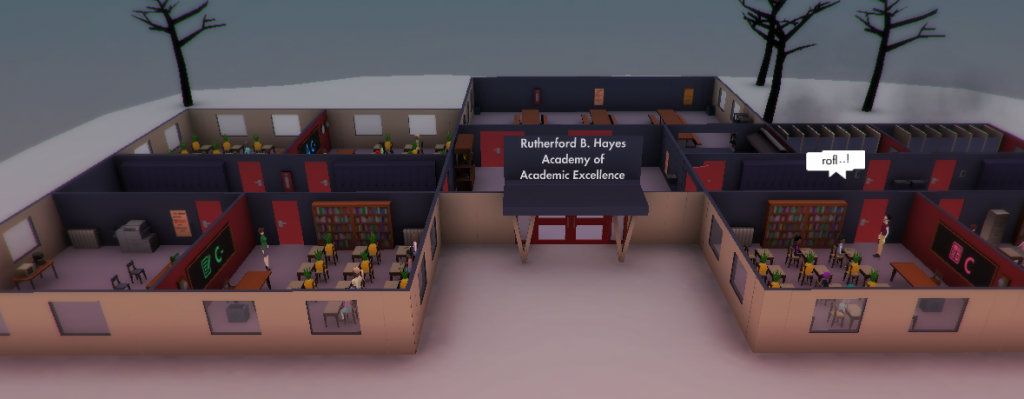
You are the administrator of a school, and you have a goal. This goal varies from scenario to scenario; maybe you’re trying to earn some money, maybe you’re just trying not to bankrupt the school, whatever.

The Rutherford B. Hayes Academy of Academic Excellence

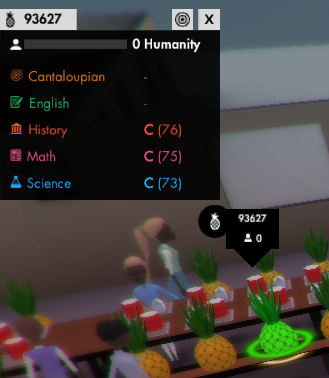
The most annoying part of running a school is, of course, the children who go there. They’re high-strung little balls of hormones who make friendships and get pissed at each other and hit on each other and form bands together and just do all sorts of annoying bullshit that isn’t SCHOOLWORK. Because at your school, your funding DEPENDS on how well your students are doing. Lower grades, less money. And time those little shits spend on interpersonal nonsense is NOT MAKING YOU MONEY.

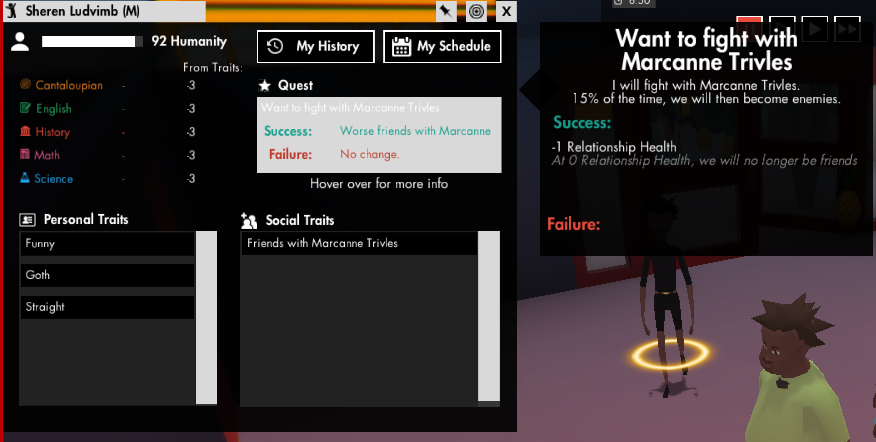
FFS, Sharen, she’s your only friend! Shouldn’t you be studying Math or something?

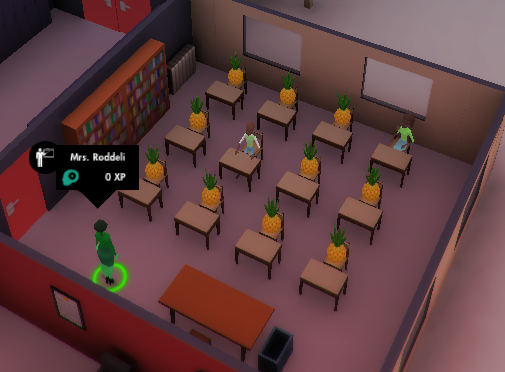
However, pineapples are way less trouble.

Look at this perfectly adequate bundle of mediocrity

Pineapples are just there. They neither find nor make trouble, they go where they’re supposed to without any fucking about, they tend to pull perfectly acceptable grades. Pineapples simply exist.

Taken at face value, this game is exactly the type of unadulterated nihilism that so severely turned me off in Headliner. The difference is that I’m quite certain this game doesn’t want me taking it at face value.

This game lives and dies by the tension between what it encourages me to do and what I, as a human being with some modicum of empathy, actually want to do. The game advises you to suppress the children’s Humanity scores; push that Humanity all the way to 0, and they become nice pliable pineapples. Conversely, if you let your pineapples’ Humanity creep all the way back up to 100, you’re asking for all sorts of messy complications.

I, naturally, would PREFER not to suppress my students’ humanity. The game lets me go either way.

Similarly, how should you treat your faculty? Obviously, you want them to be as cheap as possible. Dealing with students costs energy, as does teaching classes. (Unless you let them just run a TV for the entire class, the “I don’t give a fuck but at least nothing bad is likely to happen” option.) Sooner or later, they run out of energy, at which point, you can just fire them and hire some fresh-faced youngster to vampirically drain instead.

This is gonna be an easy period

… or, you can notice that their energy replenishes more quickly between days if you pay them more money. This may lead to you noticing that as they gain more experience, they get access to more effective teaching techniques, thus raising the students’ grades and earning back MORE money than what you’re paying out to them.

That’s the difference between this game and Headliner. Headliner presents a system that’s so inherently corrupt that there’s nothing you can do about it, even if you want to. Pineapple gives you the option of fighting the system — and even of scoring victories against it.

Kinda. Sorta.

The game progresses. Teachers’ workloads start exceeding what any amount of salary can compensate for, so even if you care, you’re going to need to let them slack-off and let the TV do the teaching on occasion. (Assuming you do, in fact, care. Burn-n-churn remains an option.) There are so many students that it becomes difficult to keep an eye on them, and try to encourage them to stuff that maximizes their Humanity.

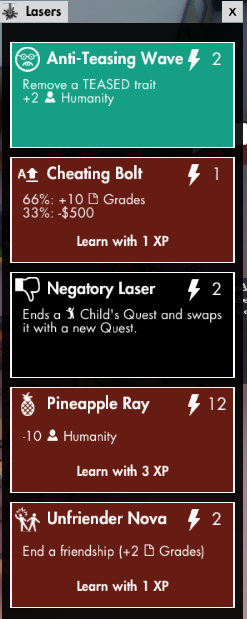
Your resources for doing that are limited. Each teacher has a laser they can use to mess with their students:

Yes, this is actually a thing that exists in the game

Make them feel better, or push them towards becoming nice, pliant pineapples. Break up fights before they start, or discourage friendships so they have more time to spend on their schoolwork.

Each time you use a laser, it costs that teacher a bit of energy. Use them wisely.

No Pineapple Left Behind doesn’t start to sing until it starts adding on layers like this, when it makes it clear that caring, although still an option, is difficult. There’s only ever so much you can do. How much do you want to exhaust your teachers policing these little shits?

(You don’t have to police the pineapples, you know. They are neither bullies nor bullied. Sure you want to discourage your students from pineapple-hood? They might honestly be happier that way.)

The playthrough when I discovered that good pay for your teachers leads to good results for the kids ended with me sacking all the teachers. I had a goal of making a net $1000 by the end of the scenario, and avoiding those pesky salaries was what I needed to get over that hump. Sometimes you just have to make the tough decisions, you know?

Or the scenario with the bus drivers’ strike, when fully a third of the school was showing up late to their first-period classes and thus getting F’s. My only goal was to keep from bankrupting the school. First period was, across the board, TV Time. It just wasn’t worth it to spend the teachers’ precious energy on partially full classes.

Oh, and then the parents start calling. They’re complaining about grades, or want you to prevent their gay son from hitting on any boys. Do you ignore the calls, or indulge them? There’s a cost to each.

The final scenario I played focused on a single student, Davis Jefferson, a pudgy boy who likes to wear makeup. Davis catches a lot of shit from the other kids, because he wears makeup. Goal for the week: send Davis home each day without the “Teased” condition.

This means ending the day with Davis’s teachers bathing him in soothing “No Teasing” lasers, at great cost to their own personal energy. It is a pain in the ass — and if the little fucker gets out the door before I can strip him of all that teasing, I lose. He sincerely might be happier if I started intentionally trying to pineapple him, he’d catch a lot less shit. At the very least, he’d make things a lot easier for everybody if he’d stop wearing make– OH MY FUCKING GOD I’M PART OF THE PROBLEM NOW HOW DID THIS HAPPEN.

This is the genius of No Pineapple Left Behind. It does not FORCE you to become a part of the problem, it entices you into it. It seduces you. It shows you how much easier everything would be if you simply stopped caring.

Caring becomes an act of defiance, of revolution. Nurturing the kids, encouraging their humanity, is an eternal battle, and the system wants you to lose. Which makes those times you can win that much sweeter.

Whoever wrote this game has serious beef with the American educational system. Depending on your own experiences within that system, this game may make you laugh, or trigger a full-on PTSD episode, or do both simultaneously.

It is two-fisted blunt-force satire wrapped in a genuinely compelling game experience. It’s honestly kinda fucking brilliant. I very much recommend it.

So the second hundred games is starting off with a bang. Is the next game gonna keep this momentum going?

Page 43, Game 12: Tabletop Archaeology 101 by avarisclari

“Are You Ready to Join the Dig?”

Damn right I am. There’s awesome shit underground. Gimme a shovel.

Justice Playthrough: The First Hundred Games

I seriously figured I’d lose interest somewhere in the mid 20’s.

A few months back, Itch.io dropped its Bundle for Racial Justice and Equality. For a minimum donation of $5, you got access to 1700+ games and game-adjacent materials. According the the page, “all proceeds will be donated to the NAACP Legal Defense and Educational Fund and Community Bail Fund split 50/50.” Groovy. #blacklivesmatter

So, I got it. Which led to the very obvious question:

WTF am I going to play?

This bundle represents the most perfect example of “choice overload” I’ve ever seen. There’s literally just too much here. I could aimlessly poke around, but surely I’d be missing some good games, right? I could look for a good “Best Of” list, but I figured it’d just be the games that already have a bit of a following. Didn’t seem fair to the other stuff that got roped in. So much was going to get lost in the shuffle.

So, there was only one way around it: roll some dice. Pick shit at random. The bundle has 59 pages, with 30 games on each page (I counted). Tell a random number generator to pick a number between 1 and 59, then pick a second number between 1 and 30, and boom. There’s my new game. And I’m going to go play it.

(I’ve since upgraded my random number generator; I used to use Random.org, but I’m now using a Perl script, which keeps track of what I’ve covered, and also scrapes the page to feed me the basic information for my copy-pasting pleasure.)

I reported my random-number-generated adventures on Facebook at first, but my wife recommended that if I was gonna do it, I should put it somewhere both more visible and less likely to spam my friends. So I resurrected my vanity URL as a blog, and here we are.

I seriously figured I’d lose interest before long, but this is FUN. I genuinely get a little excited to see what the random number generator is going to drop on me next. Even though a lot of these games are … not good. 1700 games, and David Pumpkins rules apply; they’re not all gonna be winners.

But a lot of them ARE good. A few of them are even great. It’s such a delight when I get handed something from the darkened depths of this bundle and it turns out to be a gem, something I absolutely WOULD NOT have played otherwise.

And I’ve really enjoyed blogging about the experience, even though I don’t think anyone other than my wife is actually reading these. (I COULD turn on the comments in these posts, I suppose, but that would mean monitoring my comments, and MOTHERFUCK that.) Are you reading this? Feel free to say hi if you are; I’m at pete at blairhippo.com.

Even if nobody is reading these, they’re fun to write. I like having this little record of cool new shit I was discovering. Once upon a time, I had dreams of making my living as a writer. That didn’t pan out for a variety of reasons, but one of the reasons I stopped writing even semi-professionally was the realization that the part I was most looking forward to was hearing my friends tell me I’d written a good story. Once I realized that, it grossed me out. I felt shitty about myself for chasing that external validation high, so I stopped.

I do not anticipate this will ever honestly result in feedback. And yet here I am, writing it anyway, and enjoying it, taking pride in what I’m producing. It feels good.

It’s still fun. I think I’m going to keep doing this a while longer.

But in the meanwhile, 100 entries deep seems like a good place to pause and take stock of what I’ve found.

Some simple stats: of the first hundred bundle entries I’ve explored, 65 of them were actual video games. I initially thought that’s what all 1700+ entries were, but if that 65% ratio keeps holding, it’s hard to complain.

I wasn’t expecting tabletop games to be as heavily represented as they are, and I wasn’t sure what to do about them. It’s not like I’m going to stop what I’m doing, organize a group (in the middle of a pandemic, no less), and play them. But ignoring them feels wrong. So I’ve just been going through the rulebooks, and trying to gauge how interested I would be in playing the game. Not as fair as actually playing them, I realize, but still seems better than just skipping them. Hopefully if any of their creators have stumbled upon this blog, they won’t think I’m a truly gigantic bag of cocks. Regardless, 24 of the first hundred entries have been TTRPGs, with two more LARPs.

Of the remaining nine, one was a print-n-play supplement that made me work entirely too hard to find any rules for it, so I kinda dismissed that one as “Eh, it exists.” The remaining eight entries aren’t so much “games” as “game adjacent”. Three were desktop tools of some sort (though in the case of Desktop Goose, that’s stretching the definition a bit), two were comic books, two were graphics resources, and one was a game soundtrack.

Let’s take a look back at the standouts.

Note that if you go through my reviews, there’s like a 50/50 chance I felt like a game had at least SOME merit to it — maybe it was lightweight, or more of a funny joke than a game, or I simply felt like it just wasn’t for me. The first draft of this summary acknowledged them, which turned it into a gigantic hellbeast. Let’s let the summary summarize, eh?

Recommended Video Games

This is what I came for, and I found some good ones. These were the best.

1. NOISE1

(Original review, game page.)

Yes, these are in order. And yes, of all the games I played, this crazy-ass little ASCII adventure was the one I enjoyed the most.

There are, very obviously, games on here that are much more polished. There are games I’m liable to come back to, and this isn’t really one of them. But that’s one of the things I like about it; it told its story, and it finished. I don’t NEED to play it again.

Part of this #1 ranking may be the fact that this is the first game I found in this randomized trawl that really EXCITED me. That gave me that slowly dawning realization of “Holy shit, I think I might have found something great here.” But even without that near-term nostalgia, I still admire the hell out of what this game did. With a minimalist palate, it tells a complete and engrossing story, with tense, engaging gameplay. I’ve been working with computers a long goddamn time, and typing commands into a prompt has never had me at the edge of my seat like this.

I still think the best comp for this game is Portal, but without the dark sense of humor. The puzzles are clever, and it rolls out both new obstacles and new tools for dealing with them at a pace that just feels right. The pacing kills it in general; it neither finished too soon nor wore out its welcome.

When your goofy little ASCII game has me comparing it favorably to one of the all-time greats, you’ve done something very, very right.

And the final command I typed in … look, I’m misting up over here about the fate of a couple of LETTERS ON MY SCREEN. I hope those two letters are okay. They’ve been through a hell of a lot.

Just a superb game, and one I highly recommend for anybody looking for a unique indie experience.

2. Overland

(Original review, game page.)

The most conventionally excellent game I’ve yet encountered in the bundle, and likely the one I’d be coming back to most if rolling the dice and trying something new just weren’t so. Damn. Cool. This is the one that inspired the most days where I was groggy from staying up too late playing a goddamn game.

The most obvious comp is likely FTL; it’s an adventure roguelike where you’re not so much exploring as you are looking for new resources to add. It’s challenging, and at times a bit too merciless for its own good. But there’s just a gorgeous ton of game here to explore, and I’m looking forward to making some time to get back to it.

Also, dogs are the best companions. Truly this is a game that understands some fundamental truths about the world.

3. Adjacency

(Original review, game page.)

A simple but beautiful and chill game, and another one that I’d have circled back to were it not for the preposterous to-do list I’ve placed in front of myself. The puzzles are challenging but fair, and I felt pretty damn pleased with myself when I solved them. Click the shapes, make them change colors. Are they the right colors now? Very nice. Good job, you. Care for another?

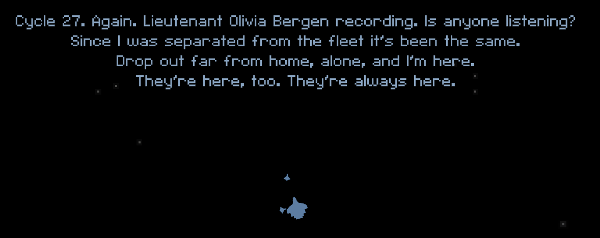
4. Cycle 28

(Original review, game page.)

Cranking the “chill” dial all the other way to “NONE WHATSOEVER MOTHERFUCKER,” Cycle 28 was the best pure fast-twitch actioner I’ve yet encountered in the trawl. If I’m in the mood for some dope-ass space gunfights, this is going to be one I come back to. Has some definite room for improvement, as my review notes, and I wish I knew how to advance the plot, but this one had me playing it over and over. Sweet game.

5. A New Life

(Original review, game page.)

Visual novel that takes the award for “Most emphatically kicked my feels in their feel-nuts.” Simple and beautiful, and more than a little topical. Take care of each other, you guys.

6. David

(Original review, game page.)

Minimalist boss-fighting game where you’re basically a big-ass pixel doing battle with other big-ass pixels. Gameplay is kinetic and exciting, forcing me to think as well as move fast. You gotta have a plan, man. You’re not defeating those sins without a plan. I defeated all the levels on basic mode; looks like there’s nothing more I can do until I defeat all of them on hard, and I don’t know if I’m that hard-core. But that’s okay. Still got plenty of game out of this one.

7. 1977: Radio Aut

(Original review, game page.)

Playable in-browser at the above link, and will take less than 15 minutes of your time. This is less of a game than it is interactive art. It’s a tribute to one seriously brave dude who, prior to this excursion, I’d never even heard of. Rest in power, Peppino.

8. Sagebrush

(Original review, game page.)

Not so much “horror” as “low-key creepfest,” Sagebrush is indeed a wonderfully creepy, moody game about coming to terms with the past as you explore a cult compound where very bad things once happened. The voice acting requires you to be a touch forgiving, unfortunately, but there’s a really solid experience here if you’re willing to look past it.

9. One Night Stand

(Original review, game page.)

The first game I played in the bundle, and the only one I didn’t choose at random. This is a combo of visual novel and point-and-click adventure game. There’s a lot of warmth here as you attempt to piece together and work your way through an incredibly awkward situation. This is another one I’ve been meaning to come back to in an effort to get other endings. Though at least I made my walk of shame clothed and with a bit of aspirin in me; that’s gotta count for something.

10. Kids

(Original review, game page.)

Less game, more artsy interactive animation. Kids is weird, perplexing, and often a bit unsettling, but it never lost my attention, and I damn sure still remember playing it. I still don’t think I have a handle on just what the hell this game really is, but whatever it’s trying to do, it went and did the piss out of it. Now go jump in that hole. All of yinz.

11. BasketBelle

(Original review, game page.)

Stylish, beautiful basketball-themed puzzle-solving platformer. Loses some points for making some of its puzzle a tad arbitrary, but it’s a unified and damned satisfying gaming experience I can definitely recommend.

12. The Guilt and the Shadow

(Original review, game page.)

The starkest “feel-bad” entry on the list, this is a darkly lovely game of exploration and despair. I’d have liked it more if I didn’t feel like the underlying story was working so damn hard to keep me at arm’s length, but there’s enough here to satisfy. This is less of a game than a mood, and it maintains that mood perfectly.

13. Winterlore I

(Original review, game page.)

Another game I’d have enjoyed more if I’d felt more connected to the story, this point-and-click puzzle solver nevertheless kept me engaged enough to see it through to the end. I wanna see where it goes next, and hope I’ll get to find that out later.

14. Touhou Fan Game Jam Black Lives Matter Collection

(Original review, game page.)

If you missed out on the larger bundle but still want to turn a donation to charity into playable games, here ya go. I refer you to my original review for the game-by-game breakdown. Some of the games here are crap, others are interesting trifles, others are surprisingly damned good.

Recommended Physical Games

Note that in most cases these recommendations are untainted by actual game experience. Nevertheless, these are the games I’d most be interested in playing.

1. Costume Fairy Adventures

(Original review, game page.)

Thoroughly realized game of goofball fairy misadventures. It’s very easy to imagine a group that would have an absolute blast with this guy.

2. Hot Bro Gay Dragons

(Original review, game page.)

Hey, it’s the one I played! Fun, silly way to spend some time telling someone you love how awesome they are. Also, pretend to be enormous and gay.

3. Ironsworn: Delve

(Original review, game page.)

Game supplement for a game I don’t play about an aspect of fantasy RPGs that tends to bore me, yet somehow makes me want to check out the game and do the stuff I normally find boring. Neat trick.

4. Dragon And Warrior

(Original review, game page.)

A role-playing game where you’re collaboratively creating a board game that you could probably go back and base a video game on, which you could then sell on Itch.io. It’s the game nerd circle of life!

5. The Stars Whisper

(Original review, game page.)

LARP. One-shot. Could be deeply moving with the right crowd. If you’re interested, don’t read the rules, just try and strong-arm whoever normally does your LARPs into running it for you.

6. A Mother’s Love

(Original review, game page.)

Solo game/writing exercise that needs cards and a Jenga tower. Win or lose, you might get a pretty solid short story out of the deal.

Recommended Other Stuff

The best of the oddities I’ve encountered thus far.

Voles of the Dusk

(Original review, game page.)

Comic book piss take of the post-apocalypse, starring rodents.

Desktop Dungeons Original Soundtrack

(Original review, game page.)

Fine goblin-punchin’ music. Also available on Spotify.

Pixel Spaceships

(Original review, game page.)

Look, I have no use for art assets for a pew-pew space shooty game. But if you’re working on a project like that and are all “Damn, the gameplay is there, but my spaceships all look like ASS,” here’s your solution.

Desktop Goose

(Original review, game page.)

“What if my desktop were plagued by a simulated goose that occasionally wandered by to be an asshole to me?” said nobody, ever. And yet this exists.

Dishonorable Mention: Headliner: NoviNews

(Original review.)

I don’t want to rehash my negative reviews. I’ve thwacked those games once; handing them an encore beating just feels mean and shitty. But this one deserves some special recognition.

When I initially reviewed it, I came down hard on it for being on the wrong side of history, but honestly felt a little bad about it. It’s not like the game devs could have had any idea that pandemic denialism would be so grody two short years later. I ultimately backed down and gave the game a tentative recommendation; it really does look great, and it really does what it’s setting out to do.

But the more I thought about it, the more I realized that what it’s setting out to do is actually pretty awful. So I want to make it clear that when I left this game out of my recommendation list, it wasn’t an oversight, it was a deliberate snub.

The modern media landscape really is more than a bit fucked-up. Bias and agenda-pushing are both endemic, so much that one major “mainstream” news outlet is little more than a propaganda wing for one of the country’s two major political parties. That same party relentlessly attacks all sources of uncomplimentary news as illegitimate, creating an immensely toxic environment where nobody knows what to believe, and everybody is actively cultivating their own personal reality bubbles.

Headliner presents itself as an attempt to explore this dynamic, as a way of showing how the news is tempted to push an agenda. It does nothing of the sort; instead, it asserts that the news HAS NO CHOICE but to push an agenda. There is no objective truth, there is no way to balance the need to entertain against the responsibility to inform.

There is no point to demanding that a news outlet do better, because it literally cannot. It’s simply a matter of what “truth” it shall attempt to coax into reality, what flavor of propaganda it’s going to peddle. Expecting anything else is naive. Everything really is just “fake news,” and there’s nothing you can do about it.

To which I say: fuck off. Get the fuck out of here, and take your cheap adolescent nihilism with you.

Fuck this game.

What Comes Next?

Am I going to do ANOTHER hundred games?

Fuck if I know.

But I can, at least, do game #101:

Page 17, Game 20: No Pineapple Left Behind by Seth Alter

“Dehumanize kids and make money.”

Oy. What have we said about “cheap adolescent nihilism,” bundle? Am I gonna need to put my rantin’ pants on for this one too?
Justice Playthrough #100: Purplest Prose

Why is it competitive?

Page 32, Game 12: Purplest Prose by Pammu

You and your friends are all trashy romance writers, collaborating to produce some trashy romance. Everybody will roll-up the two leads and a basic premise based on the chart on the second (final) page of the rules, and pitch their “idea.” Players will decide as a group which one they want to run with. Then, writing!

The game will go through multiple rounds, covering various pieces of the story — character introductions, first meeting, when do they fall in love, when do they first bang, etc. Players have two minutes to write their version of this section on a notecard. All notecards are passed to the Editorial Assistant (a rotating position who must sit out of the fun part each round), who will then read all the submissions and choose which one to add to the story. Whoever wrote the winning entry gets a little token, a new player becomes the Editorial Assistant, and play proceeds until the novel is complete! Whoever gets the most tokens wins.

I have no doubt that the person who created this game played it and had a lot of fun with it. So when I say that it’s “insanely underdeveloped,” please know that I’m not trying to imply that they didn’t bother playtesting it at all. I’m sure they did, and I’m sure they and their friends had a lovely time. I’m sure they then said “Hey, we had a great time, let’s write down these rules and call it done!” and moved on.

No, the reason I’m calling this game insanely underdeveloped — and it is INSANELY underdeveloped — is I get the feeling they stopped trying to find the BEST version of this game very quickly. This feels like an extremely early iteration of the core idea. I see so many problems here, problems that could have — and should have — both come out and been fixed with more playtesting.

First, why is it competitive? Each round, only one person’s section will be added to the finished work. You’re basically simulating the experience of submitting fiction to a slushpile and waiting for a response. I used to be a semi-pro writer; that shit is NOT FUN. It’s frustrating. It sucks. This game very much depends on having a table full of players who are all of roughly equivalent writing skills. If there’s a really striking skill disparity present, I would expect some players to have a really shitty time as their work gets rejected over and over in favor of what their more polished friends produce.

I imagine the rules saying to develop a writer persona are meant to mitigate that; your friends aren’t rejecting YOUR writing, they’re rejecting the writing of Frank Wierzboski, a former construction worker who turned to writing cuz he’s been going a bit stir crazy collecting workman’s comp all day after he fucked-up his back on the job. (“He pounded her like a pneumatic hammer being operated by a teenager with insufficient training.”) It’s a good idea — and one that’s completely undeveloped, meriting only a couple of throwaway paragraphs. Why not flesh that out a bit more? Maybe even add a THIRD page to the rules?

But even then, why does only one player’s contribution get immortalized each round? And why does one player need to sit out of the fun bit each time? Instead, why not make it more like Writey Drawey?

For the uninitiated, Writey Drawey (also known as “Eat Poop You Cat”) is my wife’s favorite party game. All you need is a whole fuckton of index cards and some pens. You make a stack of seven cards for each player. At the start of the game, everybody writes a simple phrase on the top card, and passes the stack to the left. Then, each player looks at that phrase, puts the card on the bottom, draws a picture meant to represent that phrase, and passes the stack to the left. Then, each player looks at the picture, puts the card on the bottom, writes down the phrase they think that picture was supposed to represent, and passes the stack to the left. And thus the cycle continues. Once all the stacks are complete, players take turns revealing the full chains of madness that they as a group have just created.

The great thing about this game is that even though drawing is an integral part of it, the game levels the playing field. Skill is optional. Crude stick figures may struggle to convey as much meaning as better-drawn pics, but they can be just as funny — if not even funnier.

Also, Writey Drawey has no formally declared winner. It doesn’t need one. It’s effectively a co-op game where the goal is to make each other laugh. Spoiler: you’re probably all gonna win.

I feel like there’s a version of Purplest Prose that learns some lessons from Writey Drawey and, instead of creating ONE novel, creates SEVERAL, one for each player at the table. EVERYBODY’S initial pitch gets accepted. Then, everybody writes down the first section (“Introduce Character A”) on the first card. They they hand their stack to another writer, who reads what they’ve written and writes the next section themselves (“Introduce Character B”). Everybody’s contributions, no matter how wretched, are added to a finished product. Everybody gets to play, nobody has to sit the round out. At the end of the game, everybody reads the finished products to the table. I’m willing to be they’ll be disjointed, wretched, and hilarious.

So, during the game, who do you hand the cards to? Do you just give ’em to the player on your left, or is there some way to mix it up more than that? And how far back are players allowed to read? Surely they need to know the core characters and concept, but are they allowed to read EVERYTHING that’s come before? Or is that part of the game — you need to quickly skim what other people have written, because the clock is ticking and you need to get YOUR shit written down?

I honestly don’t know. That’s why you take ideas like this, and playtest them. You see what works best. You see what problems emerge, and come up with ways to solve them that keep everybody having a good time. You see what’s the MOST fun. This is how you develop a game.

This is what Purplest Prose needed to become more than a cool idea for a game. There’s a fun little writing exercise here, and I have no doubt that if you have the right circle of friends, you’d have a good time with it. But I have no confidence that this represents the best game that could be derived from this exercise.

But what the hell, the charts on the second page of the rules have some work behind them. They might be a solid starting point if you wanted to take a crack at making that game yourself.

All right, up next … is going to be something planned.

100 reviews. That merits a bit of a retrospective, not just another dice roll.

Justice Playthrough #99: Jet Buster

ShootashootashootashootaSHOOOOOOOOOOOOOOT!

Page 34, Game 28: Jet Buster by JackDarx

This is a vertical scroller-shooter with the emphasis on SHOOOOOOOOOOOOT.

Also, you’re a cat lady singer. Just roll with it.

You shoot things that are trying to shoot you, with both of you spamming terrifying quantities of pew-pews at each other. Seriously, there’s no reason to ever take your thumb off the “SHOOOOOOOT” button.

I’m largely unfamiliar with this genre; I always dug 1942-style shooters, but this is that dialed up to ELEVENTY BILLION, and I’m pretty confident that’s it’s own thing. So, I’m not really in a position to know whether this is introducing some worthwhile twists of its own or if it’s just More Of The Same. But, that does make me vaguely blank-slate-ish, so I can evaluate it sort of on its own terms.

This thing is a bastard to screenshot, though; if I take my fingers off the dodge and SHOOOOOOOOOOT buttons long enough to get a screenshot, I asplode

So, how is it?

It’s … all right. There’s definitely a fun bad-ass feel to darting around blowing the unholy crap out of anything and everything. But it might be too much of a good thing. There’s just NO REASON to stop shooting, ever. The game often boils down to figuring out how to weave my way through the torrents of return fire so I don’t get blowed up. This means I’m often focused on a comparatively narrow portion of the screen, and just trusting that other stuff is probably blowing up the way I need it to.

There are some ideas here that the game doesn’t do a great job of explaining. When stuff blows up, coins start drifting down the screen. (They’re translucent and difficult to see, but given how much this game has a vested interest in reducing screen clutter, that’s not a bad call.) When you catch them, a meter goes up! Why do I want that meter going up? I’m … not sure. More numbers means more better, right?

You DO use the coins to continue; run out of lives, you’ll need X coins to continue. Not enough coins, go back to the beginning. I quite like this; it’s a clever approach.

You can change to a different shooting mode by holding down a particular button as you shoot (which is awkward — why not just make it a shootin’ button in its own right?), which is less efficient but causes opponents to drop medals instead of coins. I eventually figured out those medals are what allow you to purchase unlocks elsewhere in the game. There’s apparently some sort of connection between the coins and the medals, but I’m not sure I get what it is.

Ultimately, it’s too fiddly for my liking, too unforgiving. Finding the gaps in a gigantic bullet maelstrom just isn’t my bag. But if it’s yours, this game is probably worth a look. Maybe it’ll be too familiar, but maybe it’ll give you something new.

All right, random number generator. Wanna close out the first 100 games with something cool?

Page 32, Game 12: Purplest Prose by Pammu

“A Trashy Game About Trashy Writers Writing Trashy Romance”

Heh. All righty then.

Justice Playthrough #98: Gataela

This is not ready.

Page 24, Game 18: Gataela by Atemly Games

In light of the fact that this is a pre-release demo, I’m going to try to limit the degree to which I go all jerkass critic on this one. But I want it on the record that going FULL metal jerkass was absolutely on the table here.

This is a top-down JRPG. You’re a shopkeeper’s assistant, in a land that had a devastating civil war ten years ago (but things seem pretty all right now). You’re trying to help out your friends and employer; times are tough, work and money are both scarce.

First, as much as I dislike this game, credit where it’s due: it LOOKS fantastic.

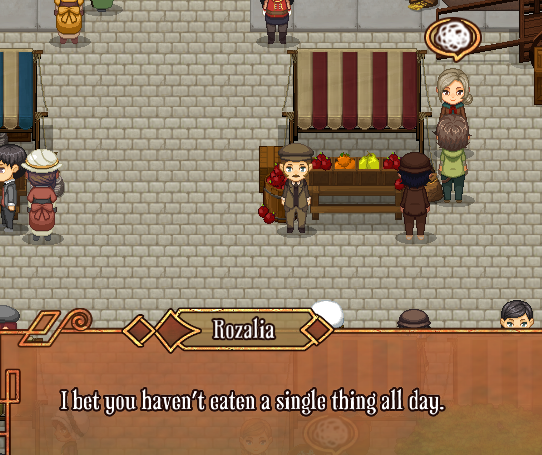
Fruitstand Lady is honestly a really nice boss

The world looks warm and appealing, the incidental bits have a nice sense of steampunk flair. It’s a completely credible looking game.

Playing the game, unfortunately, is where things start coming apart.

For all the opening text sets a Fate of Nations kinda tone, the story starts off very small. Your introductory “quest” is running down a kid who stole a loaf of bread while you were on your lunch break. I’d say that you get to choose whether to go all Javert on him or not, save that I don’t recall actually getting a choice; the merciful option appeared to be the only one available to me. Hell, even the clever option of trading him my lunch so I could return the loaf of bread wasn’t something I came up with, it was just assumed.

Which is fine, I guess. I tend to go the Good Guy route pretty hard when I have the choice. Just raised my eyebrows a bit when that was the ONLY option.

The great Loaf Caper is the tutorial quest, and you get into your first fight, where the game reveals that it’s going the Final Fantasy turn-based route. This is the first really severe problem: the combat is boring as hell.

Not sure these guys understand how “punching” works

You punch, they punch. Somebody’s gonna run out of hit points, and whoever runs out first loses. That’s it. Just stand there and trade shots.

You can choose to dodge or block, but … why? You can’t block them to death, you must punch. So, punch.

There’s also a “debate” mechanism, which the game treats as some sort of major innovation. Some characters want to “debate” you, which means “Have a conversation that isn’t inconsequential background chatter.” To the debate screen we go!

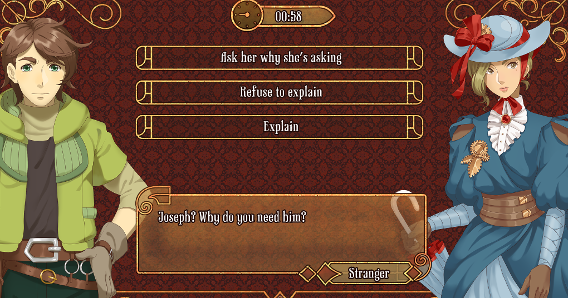
Much debate! Very conflict!

In order to “win” the debate, you must select the correct dialog options. Which ones are correct? Eh, guess. It’s not like you have any way of knowing.

Choose the wrong dialog option, lose the debate. But, don’t worry, you can just restart the debate at no penalty whatsoever, save for the real-life time you wasted.

This is deeply unsatisfying. But, given that this is how the plot advances, there needs to be SOME mechanism for letting you recover from whatever faux pas you just made.

The plot wasn’t grabbing me. I appreciate that it was trying to keep things small-scale and intimate before gradually expanding in scope, but the opening text put me in exactly the wrong frame of mind to care about helping my boss keep her fruit stand running.

Unfortunately, following that plot is where the game irrevocably lost me.

To figure out what was up with her supplier, I had to travel to a nearby town and ask WTF was going on. This is, naturally, dangerous, as one would expect from the conventions of the genre.

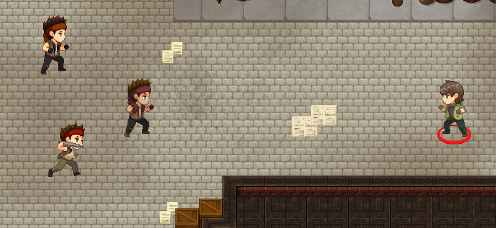
Yeah, that is not the exclamation point of Snek Friendship right there

However, fighting triggers the fight minigame, which, as I’ve established, I hate. So, I avoided it wherever possible.

I get to the town, I eventually have a chat with the supplier. I work out a deal where he’ll provide the fruit for a little more money. And then, IMMEDIATELY after the conversation concludes, three goons jump me and BEAT THE LIVING SHIT OUT OF ME. Game over.

The fight was not even remotely winnable. There were no other choices I could really make; just punch, punch, punch. The three of them ran me out of hit points WAY before I could return the favor.

The way the game is set up, it looked like I could have at least two other companions. You can also get gear. I had neither. So, I reloaded the game, and retreated all the way back to my home town to see if I missed any gear or allies.

Gear is outrageously expensive. I DID find a weapons shop, where a set of brass knuckles cost about twenty times the cash I had on me. I started talking to people in the hopes that some of them would turn out to want to join me, but go no hint that anybody might.

I wandered around a bit and found some random junk in the countryside, but nothing that would turn the tide of a curb-stomp battle. I did grind a bit, though, and managed to make third level.

Wondering if perhaps that was enough, I returned to the site of the massacre, redid the conversation, and retriggered the fight. I once again got the shit beaten out of me, but did a lot more damage on my way to the grave (without getting particularly close to winning). So, does that mean I need to be fourth level to have a reasonable chance of winning? Or maybe fifth?

Whatever. I believe one of two things happened here:

The first is that I was SUPPOSED to find some combination of companions and/or gear, but managed to completely overlook them. If this is the case, then the game is doing an abominable job of directing me towards them, because I was actively looking for them and came up empty.

The second is that the game wasn’t expecting me to simply beeline for the main storyline, and was indeed counting on me aimlessly faffing about in the countryside until I gained more levels. Given how boring I found the combat to be, that was simply not going to happen. Perhaps there were some side quests I could have tripped over?

Regardless. Either the game is so poorly designed that I cannot trust it to guide me to the resources I need to advance, or it has so little faith in its main storyline that it doesn’t think I’m likely to pursue it. Neither theory makes me interested in continuing.

As mentioned, this game is in an early state. And like I said, it looks fantastic. I did appreciate the feel that I really was a member of a community, that there was plenty of shit going on around me that had nothing to do with me. It really did feel like a living city. But neither of the game’s two big conflict resolution mechanisms were at all interesting to me: combat is rote and tedious, and “debate” is a simple matter of guessing the correct dialog path over and over until you get it right. Even if I wasn’t savagely murdered for caring about the plot, I really don’t know that I would have bothered following all the way through to the end of the demo. There’s just not much game in this game.

Hopefully this next one will be more fun to play:

Page 34, Game 28: Jet Buster by JackDarx

“90s Anthro Bullet Hell Action”

Fuck yeah.

Justice Playthrough #97: The Stars Whisper

Whoa. That was heavy as fuck.

Page 45, Game 9: The Stars Whisper by Wheel Tree Press

In this game, you and between 7 and 11 of your friends (and one facilitator) will pretend to be stars. This entails lying in a dark room in a very specific place in your constellation, whispering to each other (space is BIG, you guys) and playing with your flashlight (and the light on your phone will do nicely, assuming your battery can survive that much use). What do stars have to say to each other? The game has some ideas. See what you wind up saying.

This is less of a “game” and more of a facilitated experience. I don’t want to say too much about it; the rules specify that it works best if the players come in relatively cold only knowing the rudiments, and having looked through the entire ruleset, I believe it. For the right group of players, one interested in tackling some REALLY hefty emotional themes, this could be one hell of an experience. Something that’ll have the players involved saying “Hey, remember that time we all pretended to be stars at Nick’s place?” for YEARS, possibly as a prelude to discussing some really difficult shit.

The game advises warning players that it deals with themes of isolation and loss, so … yeah. I can say that without spoiling anything.

If you and your LARP buddies would like to do something a bit more resonant than punching goblins and don’t mind ending the night in a somber and contemplative headspace, this looks like it might be one hell of a game. I haven’t actually played it, but I’m quite comfortable recommending it.

Okay, script. Got anything maybe a little lighter for me?

Page 24, Game 18: Gataela by Atemly Games

“A Victorian Steampunk RPG! Debate, convince and negotiate with NPCs in order to save the country!”

Yeah, let’s do a colonialism. But, like, with gears and shit.

Justice Playthrough #96: black mass

What if Pixar, but 17th century puritan witchcraft?

Page 15, Game 27: black mass by will jobst

In Black Mass, players will be taking the roles of Lydia and Catherine, a girl and young woman (respectively) in 1690 Salem. They’ll be fleeing into the woods for the titular black mass, where they’ll discover … something.

What are they fleeing from? What are they going to discover? That is, of course, what you’re playing to figure out.

If you’re familiar with the indie games scene — or, if you’re bouncing through a gigantic pack of indie games at random without actually playing them because fuck it the world is ending and what else are you gonna do, but yinz may or may not relate to that one — that description probably gives you a pretty clear vision of what the game is like. Something small, just a few pages, that gives a few broad outlines and leaves the bulk of figuring out the game in your capable hands.

You would be wrong. So completely, utterly wrong.

Even cutting out the illustrations and Kickstarter thank yous, the rulebook is easy 50 pages’ worth of material. This game is very highly structured, and the book walks you through all of it.

For starters, just what kind of “witchcraft” are we talking about here? The game suggests playing in one of three fundamental “modes:” basically, you’re either talking full-on broomsticks and boiling cauldrons shit, historically accurate psycho-drama, or some combination of both being used for some blood-on-the-snow horror.

From there … remember how I specified that you’ll be playing Catherine and Lydia? And are you still confused by my throwaway Pixar joke in the cold open? No matter how many of you there are playing the game (and one of you will be acting as the GM), you will be controlling these two pre-defined characters Inside Out style.

Each of you will choose from one of the nine personas defined for each of the two girls. Perhaps you will be Catherine’s love of music, and Lydia’s tendency to creepy-whistle. Or Catherine’s fondness for secrets, and Lydia’s relationship with the woods. You’ll take turns “driving” at various stages of the game — and the game has very well-defined stages.

You’ll also use a Tarot deck to figure out what’s going on, with cards that compliment and/or conflict with whatever persona you’re currently inhabiting. You will assemble the cards at various stages, and you will tell a complete story.

This game intrigues me. Not enough that I would want to put a group together to play it (post-pandemic), but it’s such the polar opposite of so many games I’ve encountered. The focus is comically narrow, down to specifying the names and ages of the two girls at its heart. But the game explores that topic with intense structure, and clearly has a ton of work and thought behind it.

The end result is something unique and intriguing. I don’t know that I’m into it enough to put the work into manufacturing an opportunity to try it, but I’d take that opportunity if it happened by. Very cool game.

But will this game be as innovative?

Page 45, Game 9: The Stars Whisper by Wheel Tree Press

“A LARP for 8 to 12 players that asks: what do stars talk about as they shine into the void of space?”

Oh, you know, star stuff. Hydrogen burn rates, gossip on who’s gone supernova, that sorta thing.

Justice Playthrough #95: Cycle 28

On the one hand, it’s easier than I’d like to come up with a bunch of reasons why this is not the best possible version of this game.

On the other, the version of this game that actually exists is pretty fuckin’ dope and is the most satisfying action shooter I’ve yet encountered in this playthrough.

Page 11, Game 3: Cycle 28 by Pill Bug Interactive

It’s Groundhog Day! But in space, with laser cannons.

Your ship is alone, and facing steadily increasing waves of enemies who would like you to die now, please and thank you. Your in-game character is actually aware of this situation, and would like to figure out WTF is going on so they can escape their explosion-laden time loop.

This is the first fight, so apparently, ya girl has been doing this for a while before you even showed up

You have the Asteroids control panel, with your key moves being rotate, thrust, and shoot. The physics are Newtonian, but with a speed limit; you can only get yourself moving so fast. Also, your guns have non-trivial recoil, so you can use them as reverse thrusters. You have a lot of space to work with, more than can fit on one screen, but it’s not infinite.

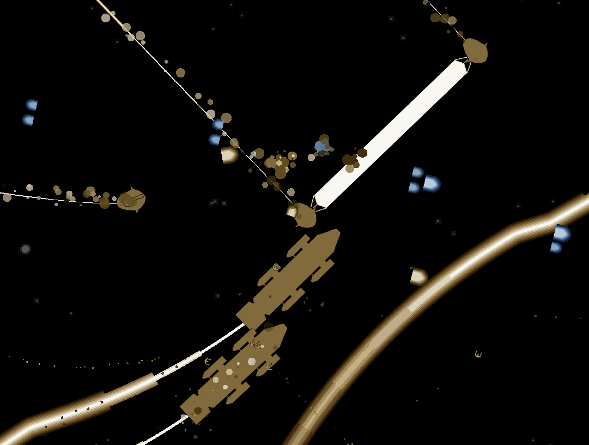
Enemies start relatively small, but get bigger quickly. Before long, sniping at a couple of corvettes not much larger than you turns into exchanging torrents of gunfire with carriers and battleships and big freakin’ THINGS that are going to try and ram you into oblivion.

IT’S ON MOTHERFUCKERS

Your ship can take a beating, but your hit points are finite. When you notice you’re in trouble, try and get yourself out of the fight; your ship will regenerate as long as you’re not shooting your guns. Then once you’re no longer trailing smoke, get your ass back in there.

What Cycle 28 Gets Wrong:

  • The game is remarkably stingy about teaching itself, and you have to rely exclusively on trial and error. That thing about being able to regenerate when you’re not shooting? Had to figure that one out myself. Also, some things you can fly through, others will damage you should you collide. The enemy ships you CAN’T fly through all appear to have bright colors, but you can’t use that as your only visual indicator of danger, because they also leave bright glowy exhaust plumes behind them, and those appear to always be harmless. Honestly, there’s just a lot of visual clutter in general, including some background stars that it took me a hot minute to realize I could simply ignore.
  • There’s also a score multiplier that I’m pretty sure increments itself after you kill X number of enemies, but then resets itself back to x1 when you take a hit. In practice, the only real way to move that particular needle is to find a carrier and hose-down the fighters erupting from it. If you’re really keeping an eye on your score, you have to find one of them to fill your murder-tank back up before you go big game hunting, which was weird to me.
  • You steadily spawn drones/fighters, which are weirdly inconsequential. Hell, took me a while to figure out that you just automatically pop them out at regular intervals, and that they’re not generated in response to a button press. I liked having the little guys around, I suppose, but there was nothing I could do to control or influence them, so they were more an inconsequential background thing than something I could gear my fighting strategy towards. They seem to die pretty quickly once the fights get REALLY bonkers, and frankly that’s when I’m most in need of the help.
  • The viewable window is zoomed in much too tightly, and tends to keep focus BEHIND the direction of travel. When I’m turned around and spraying foes with endless torrents of laser blasts, this works! When I’m zooming along, it means I can’t really see what’s in front of me. That’s not cool. I wanted to see a LOT more of the battlespace than I actually could.
  • I honestly have no idea how to advance the story. I found a thing, but my only way of interacting with it — shooting it — seemed to do nothing. There was a “boss monster” that occasionally popped up, but by that point the battleground was such a shitstorm that I couldn’t really deal with it.

What Cycle 28 Gets Right:

  • Being FUKKIN AWESOME.

The frustrations I had with this game are real, and will likely keep my from coming back to it. But I played the absolute HELL out of this game, and would probably keep playing it some more if I weren’t so curious to see what else the Justice Bundle has to offer.

Zooming in, blasting away, and trying to evade fighter swarms as my ship repaired itself was just plain FUN. The “Oh shit!” moment of realizing another swarm of enemy ships had cut off my escape route made for some fantastic ducking and weaving as I tried to find a NEW path to safety.

Combat is kinetic and satisfying. I kept feeling like a nimble, deadly bad-ass, right up to the point where I asploded — and I had to force myself to NOT dive back in for Just One More Game when it was time to go to bed or write this review.

That’s how I know a game really has its hooks in me. When I’m talking myself into playing it Just One More Time in lieu of getting some sleep … well, fuck it, being tired sounds like Tomorrow Pete’s problem. LET’S GO WRECK SOME SHIT.

The soundtrack kills it too, a classy synth score that did a great job of steadily escalating the tension until it became appropriate for the spectacular life-or-death hellstorms I kept finding myself in.

I wanted this game to be more than it was; I wanted it to be a little more willing to teach itself to me, I wanted to be able to zoom-out my view of the battlefield particularly once things started getting really bananas, I wanted a better sense of how I could engage with the story it was trying to tell. But even without all that, I still had a blast playing it, and am very glad to have found it.

Definitely recommended.

Okay, what wacky time loop is THIS game going to lock me into?

Page 15, Game 27: black mass by will jobst

“a game about seeking and finding in the woods of Salem”

So, gonna be either worshiping dark powers, or observing the horror of weaponized misogyny. I’m anticipating a “Play with the lights out” kinda experience either way.